
Tulsi Vivah Story for Kids: Tulsi, Vishnu and the Shaligram Wedding
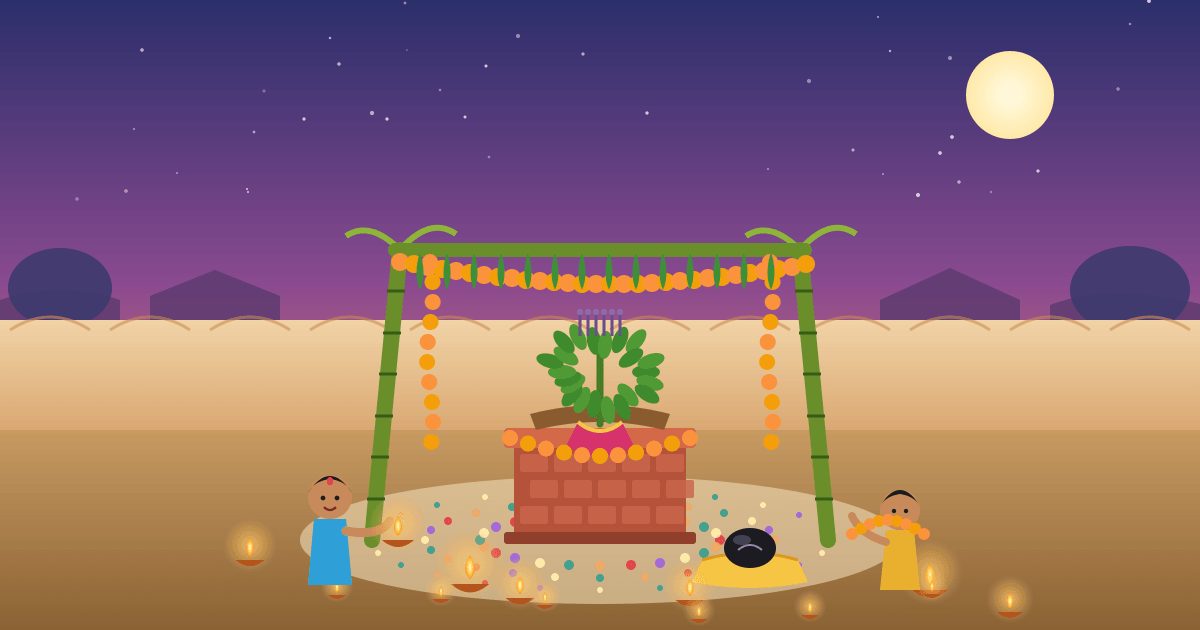
In many Indian homes there is a small green plant in the courtyard, on a raised stand, with a lamp beside it in the evening. Children are told to water it, to walk around it, and never to step on it. Then one week in November, that same plant gets a wedding. It is dressed in a sari, decorated with a bindi and flowers, and married with music and sweets. Kids always ask the same thing: why does a plant get married, and to whom? The short answer is that Tulsi (holy basil) is worshipped as a form of the goddess Lakshmi, and Tulsi Vivah is her symbolic wedding to Lord Vishnu, who is usually shown as a small dark stone called a shaligram, a picture, or an amla (gooseberry) branch.
Below is a gentle retelling for children aged about 4 to 10, which takes around five minutes to read aloud. After it you will find the other versions of the legend, how families celebrate, the 2026 date, and some questions to ask at bedtime. This is the festival that follows the Diwali week, so you may also like the Diwali story of Rama’s return, the Govardhan story, the Bhai Dooj story and the Chhath Puja story.
Tulsi and the Long Wait: a Tulsi Vivah story for kids
Long, long ago there lived a girl called Tulsi. Some say she was a princess and some say she was the goddess Lakshmi herself, born on earth for a while. All the stories agree on one thing: Tulsi loved Lord Vishnu with her whole heart. When other children played on the swings, Tulsi sat quietly by the window and thought of him.
When she grew up, Tulsi left the palace, with its soft cushions and shiny jewels, and walked all the way to the mountains. There, under a big tree, she closed her eyes and began to pray. “I wish to be Lord Vishnu’s wife,” she whispered. “I will wait as long as it takes.”
She waited through the spring, when the hills turned green. She waited through the hot summer, when the grass went yellow. She waited through the monsoon, when the rain drummed on the leaves for days. The birds built nests above her head, the deer slept beside her, and still Tulsi did not give up.
Up in the heavens, Brahma, the creator, saw her and smiled. “That girl has a patient heart,” he said. “But the wedding cannot happen just yet. There are things to be done first, and the right time has to come.” So Tulsi went on waiting, and the world went on turning.
Many years passed. Tulsi’s life on earth changed in ways that were not always happy, and the old tales tell of battles and sorrows that we will leave for when you are older. In the end, Tulsi’s time on earth came to a close, and Lord Vishnu came to see her. He was very quiet, because he knew how faithfully she had waited and how much she had loved him.
“Dear Tulsi,” he said, “you waited for me so patiently, and I am grateful. I cannot let you simply go away. I promise that you will always be close to me.”
Then something wonderful happened. Where Tulsi had stood, a little green plant sprang up, with soft leaves and a sweet, sharp smell like nothing else in the garden. Beside it, a clear river began to flow, which the old stories call the Gandaki. And in the river, among the pebbles, there were smooth, shiny black stones, the shaligrams, in which people say Vishnu stays near her.
“From today,” said Lord Vishnu, “your leaves will be placed at my feet in every prayer. Every house that has you in the courtyard will be blessed. And every year, when I wake up from my long sleep in the month of Kartika, we will celebrate our wedding together, and the whole world will join in.”
And that is why, every year, when Vishnu wakes, the people of the village gather in the courtyard. They dress the little Tulsi plant like a bride, and they bring the shaligram, dressed like a groom. They tie a thread between them, sing wedding songs and share sweets with everyone. And the old Tulsi, who waited so long and so patiently, is happy again.
This is an original, simplified retelling of a traditional story. Several versions of the legend exist, and some contain battles and sad parts, so we have told the gentle version, which is the one shared by all of them: Tulsi’s devotion, and how she became the sacred plant.
Other stories told about Tulsi
Like most festival stories, the Tulsi legend has more than one version, depending on the family, the region and the scripture. A short guide for parents:
- Tulsi as Lakshmi (Devi Bhagavata Purana). Tulsi is a form of Lakshmi, born as a king’s daughter, who goes to the holy place of Badrinath to pray for Vishnu as her husband. At the end of her story Vishnu tells her that her hair will become the Tulsi plant, and her body the Gandaki river.
- Vrinda and Jalandhara (Padma, Skanda and Shiva Puranas). Vrinda is a pious devotee of Vishnu, married to the powerful Jalandhara. Her loyalty protects him in battle, and in the end the gods have to find a way to stop him. This is a more serious tale about war and tricks, and many parents prefer to keep it for older children. In some tellings Vishnu makes sure that Vrinda is reborn as the Tulsi plant.
- The ocean of milk. Another Vaishnava legend says the Tulsi grew from a happy tear of Vishnu that fell into the amrita (nectar of immortality) when the gods and asuras churned the cosmic ocean.
- The stone. In some regional versions, a grieving Tulsi curses Vishnu to become a stone, which is why Vishnu is worshipped as the shaligram stone found on the banks of the Gandaki river.
It is a good idea to tell your child that these are traditional tales that different families tell in different ways, and that it is fine to ask elders how they tell it at home.
Why does Tulsi get married every year?
The calendar explains it. Hindus believe Vishnu goes to sleep on Shayani Ekadashi in the summer and wakes up on Prabodhini Ekadashi (also called Dev Uthani or Deothan Ekadashi), the eleventh day of the bright half of Kartika. The four months in between are called Chaturmasya, and weddings are not held during that time. When Vishnu wakes, the wedding season begins, and Tulsi Vivah is the first wedding of the season, a kind of opening ceremony for all the weddings to come. It also marks the end of the monsoon.
The ceremony itself can take place at any time between Prabodhini Ekadashi and Kartika Purnima (the full moon), and the exact day varies by region. In many places it is held on Dwadashi, the day after Ekadashi.
How families celebrate Tulsi Vivah
The wedding is held at home or in a temple and looks like a real Hindu wedding in miniature. Here is what you might see:
- The wedding booth. A small mandap (often of sugarcane stalks or flowers) is built around the Tulsi Vrindavan, the raised stand where the plant grows.
- The bride. Tulsi is dressed in a small sari and sometimes jewellery, and a paper face with a bindi may be added.
- The groom. This is a shaligram stone, or a brass or picture image of Vishnu or Krishna, or an amla branch. The groom is dressed in a dhoti and both are bathed and decorated with flowers.
- The fast and the wedding. Many families fast until the evening, when the wedding begins. The couple are joined with a cotton thread, wedding songs are sung, and sweets (prasad) are shared.
- Regional names. It is Tulasi Kalyanam in Telugu, Tulasi Maduve in Kannada and Tulshicha Lagna in Marathi.
You do not need a big ceremony to share the spirit of it with a child. A small pot of Tulsi, a little flower garland and a sweet to share at the end are plenty.
A safety note for parents: a lit diya near a cotton thread, a paper face or a silk sari is a fire risk. Keep the lamp on a steady plate away from fabric and dry garlands, and keep young children at a distance while it burns.
What the story means for children
- Patience pays off. Tulsi waits through every season without giving up. It is a nice way to talk about things that take a long time, like learning to ride a bike or waiting for a seed to sprout.
- Plants deserve care. Tulsi is watered every day in many homes. Children can take over this small job, and see that someone grows because of their effort.
- Everyone can join a celebration. Neighbours, cousins and friends are invited, and the sweets are shared. The festival is about community as much as ritual.
- Seasons change, and so do we. The wedding marks the end of the monsoon and the start of a new season, which is a gentle way to talk about change.
- Love can take many forms. In the story, devotion becomes a plant, a river and a stone: things that stay with us for a long time.
When is Tulsi Vivah in 2026?
Drik Panchang lists Tulasi Vivah on Saturday 21 November 2026 for New Delhi, with the Dwadashi tithi beginning at 6:31 AM on 21 November and ending at 4:56 AM on 22 November. Prabodhini Ekadashi, the day Vishnu wakes, falls just before it, on Friday 20 November, with the fast broken on the morning of 21 November according to AstroSage. Dates and times differ between cities and traditions, so check a local panchang or your temple calendar.
The date comes six days after Chhath Puja (15 November 2026) and ten days after Bhai Dooj (11 November), so you can read one festival story every few days from Dhanteras onwards.
How to tell this story to young children
- Start with a real Tulsi pot. Let your child touch a leaf and smell it. The story begins with the smell, and kids remember it.
- Show the seasons. Count the spring, summer and monsoon on your fingers as Tulsi waits, and let your child hold up a finger for each one.
- Skip the sad middle for little ones. For children under six, go straight from “many years passed” to Vishnu’s promise. You can add the rest later.
- Let your child be Vishnu. Ask them to say the promise (“I promise you will always be close to me”) in their kindest voice. Our guide on how to tell stories to kids without a book has voice and pause tips.
- Make a mini wedding. A paper bindi, a small garland and a sweet at the end makes the festival real. And if your child wants the same story again tomorrow, that is normal, as we explain in why kids ask for the same bedtime story.
Questions to ask after the story
- What was the hardest thing about waiting for Tulsi? How do you feel when you have to wait?
- Why do you think Vishnu promised that Tulsi would always be close to him?
- What plant would you like to look after at home?
- Who would you invite to a wedding in the courtyard?
- What is something that took you a long time, but you did not give up?
Asking questions like these is called dialogic reading, and our guide to dialogic reading at home has more ideas. For more tales about patience and kindness, try The Empty Pot, the best Panchatantra stories for kids or our moral stories for children.
Frequently asked questions
What is the story behind Tulsi Vivah?
Tulsi Vivah is the symbolic wedding of the Tulsi (holy basil) plant, worshipped as a form of Lakshmi, to Lord Vishnu. In the Devi Bhagavata Purana, Tulsi prays for years to have Vishnu as her husband, and at the end Vishnu tells her that her hair will become the Tulsi plant. Other Puranas tell of Vrinda, a devotee of Vishnu who is reborn as Tulsi. Vishnu is worshipped in the form of the shaligram stone, and the wedding is held every year when he wakes up in Kartika.
When is Tulsi Vivah in 2026?
Drik Panchang lists Tulasi Vivah on Saturday 21 November 2026 for New Delhi, with Dwadashi beginning at 6:31 AM that day. Prabodhini Ekadashi, when Vishnu wakes, falls on 20 November. The ceremony can be held between Prabodhini Ekadashi and Kartika Purnima, and dates vary by region, so check a local panchang.
Why is the Tulsi plant married to Vishnu?
Hindus believe Vishnu sleeps for four months (Chaturmasya) and wakes on Prabodhini Ekadashi. Weddings are not held during that time, so the wedding of Tulsi and Vishnu opens the wedding season. It also marks the end of the monsoon.
What is a shaligram?
A shaligram (shaligrama) is a smooth, dark stone found in the Gandaki river, which devotees worship as a symbol of Vishnu. In Tulsi Vivah it is often the groom, though a brass image, a picture of Krishna or an amla branch may be used instead.
How can I explain Tulsi Vivah to a small child?
Say that Tulsi is a plant that families care for and love, and that once a year she has a pretend wedding with Vishnu, like a big family party. People dress the plant, light lamps, sing and share sweets. Then tell the story of Tulsi, who waited patiently for Vishnu.
Sources
- Wikipedia. Tulasi Vivaha (the ceremony, the mandap, shaligrama or amla branch, the cotton thread, timing between Prabodhini Ekadashi and Kartika Purnima, regional names).
- Wikipedia. Tulasi in Hinduism (the Devi Bhagavata Purana, Vrinda and Jalandhara, Samudra Manthana and shaligrama legends, daily worship).
- Wikipedia. Prabodhini Ekadashi (the end of Chaturmasya, the start of the wedding season).
- Drik Panchang. Tulasi Vivah 2026 date and time (New Delhi) and AstroSage. Devutthana Ekadashi 2026.
Tulsi and the Long Wait is an original retelling written by the BestStories Editorial Desk. You are welcome to read it aloud at home or in class.