
Dhanteras Story for Kids: The Lamps That Saved a Prince
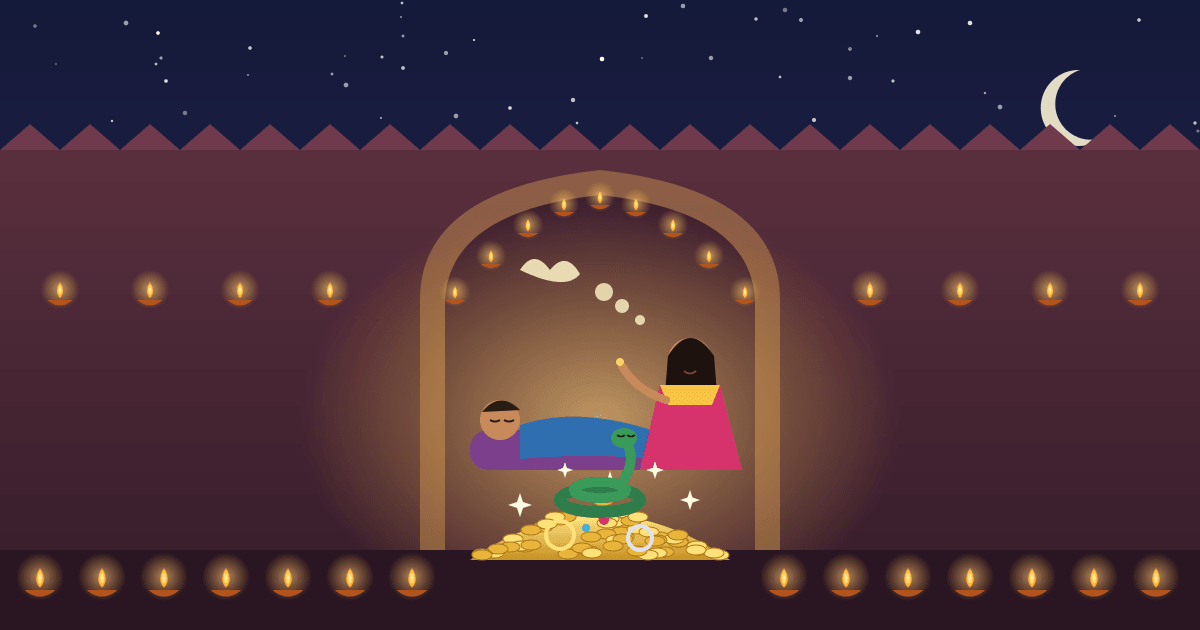
On Dhanteras evening, many families light a small clay lamp, set it outside the front door facing south and leave it burning into the night. Children notice. Why a lamp outside, and why that direction? The answer is the best-loved Dhanteras story: a clever young princess saved her husband by filling the doorway with lamps, gold and jewellery and telling stories all night, so that Yama, who came in the form of a snake, was dazzled, sat down to listen and went away quietly at dawn.
Below is a gentle retelling for children aged about 4 to 10. It takes around four minutes to read aloud. After it you will find the second Dhanteras story, about Dhanvantari and the pot of nectar, where both stories come from, what they mean, the 2026 date and some questions to ask at the end. Dhanteras is the first day of the five-day Diwali festival, so it is a good way to begin our festival series with the Narakasura story, the Diwali story of Rama’s return and the Govardhan story.
The Princess Who Lit a Hundred Lamps: a Dhanteras story for kids
Long ago there was a kind king called Hima. He and the queen had one son, a cheerful prince who loved horses, mangoes and long walks by the river.
When the prince was born, a wise old star-reader looked at the sky and frowned. “This child will grow up strong and good,” he said. “But take care. On the fourth night after his wedding, danger will come for him in the shape of a snake.”
The king and queen never forgot those words. The years went by, the prince grew tall, and one day he married a bright, brave princess. She had a quick mind and a warm laugh, and more than anything she loved stories.
On the third day after the wedding, the queen told the princess about the warning. The princess did not cry and she did not panic. She sat very still and thought.
“A snake comes quietly in the dark,” she said to herself. “So there will be no dark. And a snake bites when a person is fast asleep. So nobody will sleep.”
On the fourth evening she got to work. She filled clay lamp after clay lamp with oil and set them all around the room, along the windows and all the way down the corridor. Ten lamps, twenty lamps, fifty lamps, a hundred lamps. The palace glowed like a little sun.
Then she opened her jewellery box. She took out her gold bangles, her silver anklets, her necklaces and every gold and silver coin she had been given at the wedding, and she piled them in a shining heap right across the doorway. When the lamplight touched the heap, it sparkled so brightly that it hurt to look at it.
Finally she sat down beside her husband. “You must not sleep tonight,” she said. “Not even for a minute. So I am going to tell you stories.”
“All night?” asked the prince, already yawning.
“All night,” she said, and she began.
She told him about a clever crow who dropped pebbles into a jar. She told him about a monkey who tricked a crocodile. She sang him songs from her village, and when his eyes began to close, she asked him riddles and made him answer. The night grew deep and still. The lamps flickered. Outside, the whole city slept.
At midnight, something slid silently along the corridor. It was a snake, long and dark, with bright little eyes. It was not an ordinary snake. It was Yama himself, the god who comes at the end of every life, and he had come for the prince, just as the star-reader had said.
But when Yama reached the doorway, he stopped. Light was everywhere. A hundred lamps blazed in front of him, and the heap of gold and silver threw the light straight into his eyes. He blinked. He could not see the way in.
So Yama did the only thing he could. He climbed up onto the heap of coins and jewellery, curled himself into a ring and waited for the lamps to go out.
They never did. The princess kept filling them with oil, and she kept on talking. And as Yama sat there in the glow, he found himself listening. What happened to the crow? Would the monkey get away? What was the answer to that riddle? Before he knew it, he was enjoying the stories just as much as the prince.
Slowly the sky turned grey, then pink, then gold. A rooster crowed. The fourth night was over, and the time Yama had come for had passed.
Yama uncurled himself, looked once at the brave princess with her lamps and her stories, and quietly slid away. He did not come back.
In the morning the king and queen found the prince safe and sleepy and the princess smiling, surrounded by a hundred lamps that had burned all night. The whole kingdom celebrated. And ever since then, on Dhanteras evening, people light lamps for Yama at their doors and remember the princess who was cleverer than the darkness.
The second Dhanteras story: Dhanvantari and the pot of nectar
Dhanteras has another story too, and it is a quick one to add at the end. Long ago, the gods and the asuras wanted amrita, a nectar that would let them live forever. To find it, they churned the great Ocean of Milk, using a mountain as the churning stick and a giant serpent called Vasuki as the rope, pulling it back and forth like a huge tug of war.
Many wonderful things rose from the ocean as they churned. Last of all came a shining figure carrying a pot in his hands. He was Dhanvantari, the doctor of the gods, and the pot was full of amrita. Because Dhanvantari brings healing and good health, many families remember him on Dhanteras, which is also called Dhanvantari Trayodashi, and pray for a healthy year ahead. You can tell children that on this day we wish each other two kinds of wealth: good things in the house, and good health in the family.
Where these stories come from
The story of King Hima’s son is a folk legend told in homes across North India, especially by grandmothers on Dhanteras evening. It explains the custom called Yama Deepam or Yamadeepdaan: lighting a lamp for Yama, often placed at the door and facing south, the direction linked with Yama. Like many folk tales, it has small differences from family to family, but the heart of it, the lamps, the gold and the stories that kept the prince awake, stays the same.
The Dhanvantari story is much older and comes from the scriptures. The Bhagavata Purana (Canto 8, Chapter 8) describes Dhanvantari rising from the churned ocean carrying the jug of nectar and calls him an expert in the science of medicine. He is honoured as the god of Ayurveda, and the word Dhanteras itself joins dhan with teras, the thirteenth lunar day of the dark fortnight, which is when the festival falls.
What the story means for children
- Thinking beats panicking. The princess hears scary news, sits still and makes a plan. That is a powerful idea for children who feel worried: stop, think, then act.
- Light pushes back fear. Darkness is where the danger hides, so she fills the night with light. This is why we light lamps on Dhanteras and all through Diwali.
- Stories are strong. No sword, no army, only stories and songs, and they are enough to keep everyone safe until morning. Children who love bedtime stories enjoy hearing that stories can save the day.
- Gold is for sharing light, not for showing off. The princess uses her jewellery to make the doorway shine, not to look rich. It is a gentle way to talk about why families buy a little gold, silver or a new pot on Dhanteras.
- Health is wealth too. Dhanvantari’s story reminds us that being healthy is one of the best kinds of riches.
When is Dhanteras in 2026?
Dhanteras falls on Trayodashi, the thirteenth day of the waning moon, two days before the Diwali new moon. Drik Panchang lists Dhanteras, Dhanvantari Trayodashi and Yama Deepam on Friday 6 November 2026 (New Delhi time). Kali Chaudas follows on Saturday 7 November and Lakshmi Puja on Sunday 8 November. If you live outside India, check your local panchang or temple calendar, because the tithi can shift the date by a day.
On the day, families clean the house, draw rangoli at the door, buy something new in metal, often a small coin or a steel pot, and in the evening light lamps, including the lamp for Yama outside the main door. In some homes in Maharashtra people offer crushed coriander seeds with jaggery, and in parts of Tamil Nadu families prepare a herbal medicine called marundu to eat early the next morning.
How to tell this story to young children
- Light a lamp first. If you are telling it on Dhanteras evening, light one diya together, switch off the other lights and tell the story by its glow. The room becomes the princess’s palace.
- Count the lamps. “Ten lamps, twenty lamps, fifty lamps…” Let your child count with you, or line up tea lights or torches as you go. Repetition like this is why kids ask for the same bedtime story again and again.
- Keep the snake curious, not scary. For under-sixes, simply say a sneaky snake wanted to come in but was dazzled by the lights and ended up listening to the stories instead. You do not need to explain Yama until your child is older.
- Tell a story inside the story. When the princess starts storytelling, pause and let your child choose which story she tells next. It is a lovely way to retell a favourite like The Crow and the Pitcher or The Monkey and the Crocodile.
- Finish with sunrise. End slowly: grey sky, pink sky, gold sky, rooster. It brings the energy down, which helps if this is a bedtime story. Our guide on how to tell stories to kids without a book has more tricks with voices and pauses.
Questions to ask after the story
- How did the princess feel when she heard the warning? What did she do first?
- Why did she use lamps and shiny gold? Why stories?
- Why do you think the snake stayed to listen?
- If you had to stay awake all night, which story would you tell?
- What else can we be thankful for besides money and things? (Health, family, friends.)
Talking about a story like this is called dialogic reading, and our guide to dialogic reading at home has more easy question ideas. For more tales from Indian tradition, try the best Panchatantra stories for kids and our Jataka tales for kids.
Frequently asked questions
What is the story of Dhanteras in short?
A popular legend tells of King Hima’s son, who was warned that a snake would bring danger on the fourth night after his wedding. His clever wife lit lamps all around the room, piled her gold and jewellery at the door and told stories all night so he would not fall asleep. Yama, who came in the form of a snake, was dazzled by the light, sat on the gold listening, and left quietly at dawn. Families light lamps on Dhanteras to remember her.
Why is Dhanvantari worshipped on Dhanteras?
Dhanvantari is the physician of the gods and the god of Ayurveda. In the story of the churning of the ocean, he rose from the Ocean of Milk carrying a pot of amrita, the nectar of immortality. Many families remember him on Dhanteras and pray for good health.
When is Dhanteras in 2026?
Drik Panchang lists Dhanteras, Dhanvantari Trayodashi and Yama Deepam on Friday 6 November 2026 (New Delhi). It is the first day of the five-day Diwali festival, with Lakshmi Puja on Sunday 8 November. Check your local panchang if you live outside India.
Is the Dhanteras story too scary for young children?
It does not need to be. For children under six you can tell it as a story about a danger that never happens: the snake is simply dazzled by the lights, enjoys the stories and goes home. Older children can hear that Yama is the god who looks after the end of life, and that the story is really about cleverness, love and light.
Sources
- Wikipedia. Dhanteras (legend of King Hima’s son, yamadipadana, regional customs) and Dhanvantari.
- Bhagavata Purana, Canto 8, Chapter 8, “The Churning of the Milk Ocean”, especially verse 34 on Dhanvantari (translation on Vedabase).
- Wikipedia. Samudra Manthana (the churning of the ocean).
- Drik Panchang. Diwali 2026 puja calendar (New Delhi).
The Princess Who Lit a Hundred Lamps is an original retelling written by the BestStories Editorial Desk. You are welcome to read it aloud at home or in class.