How to Tell Stories to Kids Without a Book: A Parent's Guide
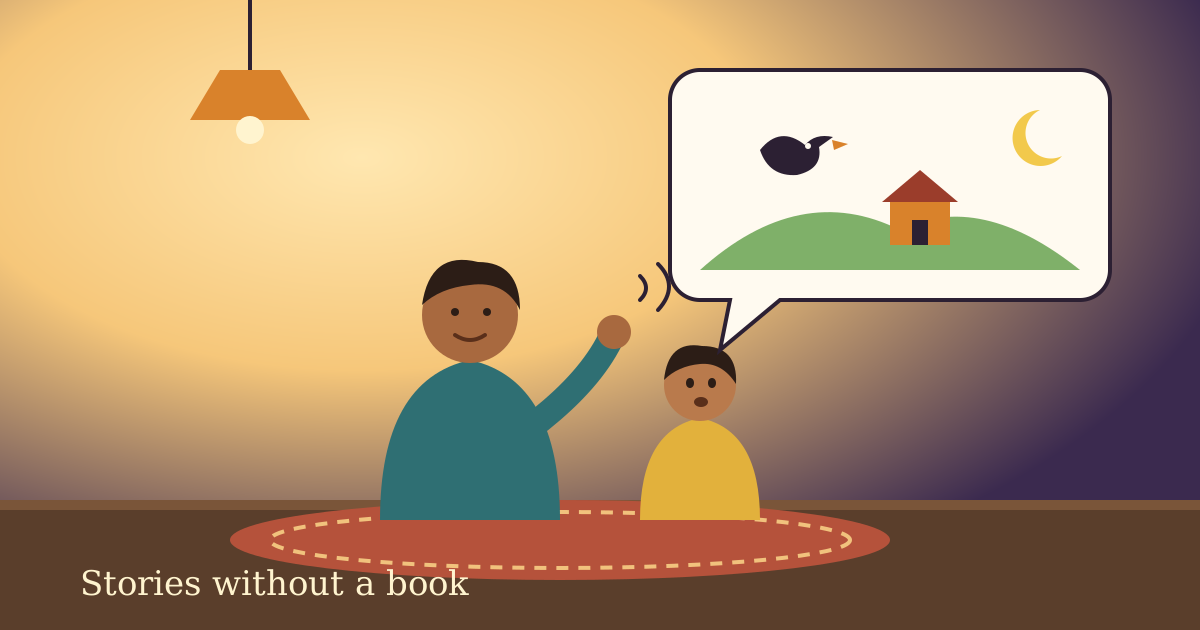
Some of the stories children remember longest never came from a book. They were told in the dark after the light was switched off, on a long bus ride, or while waiting for dinner. A grandmother who tells the same tale of a clever rabbit every holiday is doing something quite different from reading aloud, and children notice the difference.
If you have ever wanted to tell a story but froze because you were not "a storyteller", this guide is for you. It covers why telling a story is worth doing, how to remember one, how to use your voice, and how to help your child become the teller. You need one story you like and a few minutes.
Why tell stories when you could just read one?
Reading aloud is valuable, and nothing here is a reason to stop. But telling a story gives a child something extra. In an article for NAEYC, Telling and Retelling Stories: Learning Language and Literacy, early-childhood professor Rebecca Isbell compares the two. A reader usually follows the text exactly and keeps their eyes on the page. A teller can keep eye contact and change the story to suit the listener in front of them. The language of a told story is usually more informal than printed text. And because the story comes through words, tone of voice, gestures, facial expressions and movement, children can follow it even if their own language skills are still growing.
The National Association for the Education of Young Children makes a similar point for families. Its short guide Everyone Can Be a Storyteller says that storytelling helps preschoolers learn new words and get ready to become readers and writers.
There is research behind the idea of children telling stories back, too. Reading Rockets summarises a meta-analysis of story retelling by Carl Dunst and colleagues at the Center for Early Literacy Learning. It pooled 11 studies of 687 toddlers and preschoolers and found that retelling stories was linked to better story comprehension and expressive vocabulary, as well as wider gains in language and early literacy. Another study listed on Reading Rockets, by Gardner-Neblett and Iruka (2015), used data from a large, nationally representative early-childhood study. It found that language at age two was associated with storytelling (narrative) skills at four, and those were connected to early reading skills at five.
Start smaller than you think
With babies and toddlers, a "story" can be a few sentences. In a UNICEF Parenting video on reading to babies, Severino Antônio, Ph.D., suggests making up "micro narratives" while caring for a little one, simply telling them what you are doing and what you are about to do. "Telling stories is one way to care for them," he says. A bath can become a story: "Here comes the warm water. Splash on your toes. Now the bubbles are climbing up your knees."
For a two- or three-year-old, the next step is a story with a clear repeating line. For four- and five-year-olds, you can tell a full folk tale with a beginning, a problem and a clever ending.
Choose a story that is easy to tell
Not every good story is easy to tell aloud. The easiest ones share a few features:
- A small cast. Two or three characters are plenty. Children can follow who is who without pictures.
- A clear chain of events. One thing leads to the next, so you can remember it as steps rather than words.
- A repeated line or sound. Isbell describes how, in a retelling of Kipling's "How the Camel Got His Hump", the camel answers every request with "Humph!", and after the second time children often join in. Repetition gives children a way into the telling.
- A satisfying turn. Fables and folk tales are full of these: the small creature who outwits the big one, the trick that backfires.
On BestStories, The Lion and the Rabbit is a good first choice. A lion is terrorising the forest, a small rabbit arrives late on purpose, and his trick turns the lion's pride against him. Stone Soup has a built-in repeating pattern, with each villager bringing one more thing to the pot, which children love to supply. The Tortoise and the Geese has a tension your child will feel in their own body: the talkative tortoise must keep his mouth shut on the stick, no matter what. Read one yourself, then put the screen away and tell it.
How to remember a story without memorising it
You do not need to learn a story word for word, and you should not try. Isbell notes that effective tellers use their own words and adjust the tale to their audience. A simple method:
- Read it twice. Once for enjoyment, once to notice the shape.
- List the beats. Write the main events as five or six short lines. For Stone Soup: hungry traveller, every door shuts, pot and stone in the square, "it would be better with an onion", everyone brings something, the whole village eats together.
- Keep the special words. Choose one or two lines to say exactly the same way every time, such as a refrain, a name or a sound. These are the parts your child will learn first.
- Tell it to yourself once. In the shower or on a walk.
If you forget a step halfway through, make something up or ask your child, "What do you think happened next?"
Using your voice, face and hands
A told story lives in how you say it. You do not need to act. Small changes are enough:
- Slow down at the important moment. When the rabbit leads the lion to the well, drop your voice and pause before he looks in.
- Give one character one voice. A deep, slow voice for the lion is enough. You do not need a voice for everyone.
- Use one gesture per character. Flapping hands for the geese, a stirring motion for the soup.
- Watch your listener. This is the real advantage over reading. If your child's eyes widen, linger there. If they fidget, skip ahead.
Helping your child become the storyteller
The aim, over time, is for your child to tell the story back. Isbell describes how children often move from listening, to joining in, to telling. Their first retellings tend to copy the original closely. Later, they keep the storyline but move it somewhere new. Her example is the Little Red Hen becoming a boy who asks his friends to help make a pizza. She also describes a five-year-old named Jerome who heard his teacher tell "The Magic Fish" one week, heard it again the next, and then retold the whole tale to a friend in more than 500 words.
You can support this at home with very light prompts. Isbell suggests questions such as "What happens next?", "Then what did they do?", "What did he say?" or simply "And then?". Drawing pictures to use as cues, or acting the story out with toys, also helps children remember the order of events. If you have tried dialogic reading at home, these prompts will feel familiar. The difference is that here the child is building the whole story from memory rather than from pictures on a page.
Two cautions from the same article are worth keeping in mind. Let children go at their own pace, and do not push them to perform for a crowd or get it perfect. A wobbly retelling to one grandparent on a video call counts.
Everyday stories count too
Not every story needs a lion or a jinni. NAEYC suggests a few ways to turn ordinary life into storytelling:
- Turn an errand into a quest. A trip to the shop becomes a search for one particular item, told afterwards by your child.
- Tell a new event before it happens. Before a dentist visit or meeting new neighbours, explain what might happen and let your child turn it into a story. Afterwards, they can change it to match what really happened.
- "Publish" the story. Write down your child's words, let them draw the pictures, act it out with simple props, or record it to send to relatives.
Bring in family and regional tales
Many families have stories that were never written down, such as how a grandparent came to the city or a village ghost story. Tell them in whatever language they were told to you. If you would like a starting point, our Kerala Grandma Stories collection is written in the warm, spoken style of stories told in the evening by the oldest person in the house, and our guide to Kerala folk tales in English retells several well-loved tales from the region. For more short animal tales that are easy to tell, browse the Panchatantra stories.
A simple plan for this week
- Day 1: Read The Lion and the Rabbit together.
- Day 2: Tell it without the screen, using your five beats and one repeated line.
- Day 3: Tell it again, pausing for your child to fill in the repeated line.
- Day 4: Ask, "Can you tell me the beginning?" and take over when they want you to.
- Day 5: Let your child tell it to someone else, with you nearby to say "And then?"
Keep the last story of the night calm; our short bedtime stories for toddlers are written for that quiet last stretch.
Frequently asked questions
What age can I start telling stories to my child?
From birth. With babies, stories can be tiny: describing what you are doing as you bathe or dress them. Simple tales with repetition and sound effects suit toddlers, and by four or five many children enjoy longer folk tales and like retelling them.
Do I need to memorise a story word for word?
No. Remember the order of the main events and one or two repeated lines, then tell the rest in your own words. Storytellers have always changed tales a little with each telling, and children rarely mind.
Can I tell stories in my home language?
Yes, and it is often the best choice. Tell stories in the language you speak most fluently and expressively. Your child will learn more from a lively story in Malayalam, Hindi or Arabic than from a hesitant one in a language you are less comfortable with.
My child wants the same story every night. Should I change it?
Not necessarily. Hearing a familiar story again is what gives a child the confidence to join in and, eventually, tell it back. Let them choose, and try a new story on another night.