Govardhan Story for Kids: How Little Krishna Lifted the Mountain
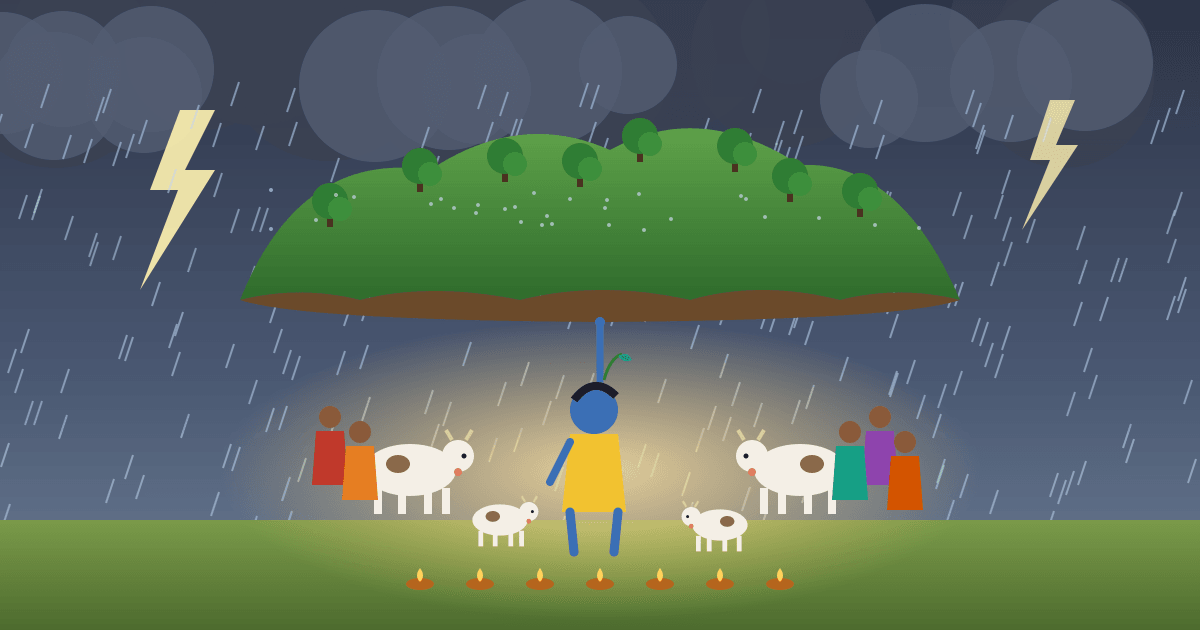
The day after Diwali, many families in North India build a little hill. Some shape it from cow dung in the courtyard, some pile up dozens of sweets and dishes at the temple, and children are told to walk around it and bow. Sooner or later a child asks: why are we praying to a hill? The answer is the Govardhan story. When Indra, the god of rain, sent a terrible storm to punish the village of Vraj, little Krishna lifted the whole of Govardhan Hill on one finger and held it up like an umbrella for seven days, so that every family, cow and calf could shelter underneath.
Below is a gentle retelling for children aged about 4 to 10. It takes around four minutes to read aloud. After it you will find where the story comes from, what it means, how Govardhan Puja and Annakut are celebrated, the 2026 dates and some questions to ask when the story ends. It is the fourth day of the Diwali festival, so it pairs well with our Diwali story for kids in English and the Narakasura story for kids.
The Hill That Became an Umbrella: a Govardhan story for kids
Long ago, in the green land of Vraj, there was a village of cowherds beside the river Yamuna. Every morning the boys and girls took the cows out to graze on the slopes of a big, friendly hill called Govardhan. The hill had sweet grass for the cows, cool caves for afternoon naps, streams for drinking and trees full of fruit.
Among the cowherd children was a small boy with a flute and a mischievous smile. His name was Krishna, and he was about seven years old.
One autumn, Krishna saw the grown-ups of the village rushing about. They were cooking pots and pots of rice, sweets and milk dishes. His father, Nanda, was busy counting baskets.
“Father,” asked Krishna, “who is all this food for?”
“For Indra, the king of the gods,” said Nanda. “Indra sends the rain. Every year we make him a big offering so that he keeps sending it.”
Krishna thought for a moment. “But Father, who gives our cows their grass? Govardhan Hill. Who gives us water and shade and fruit? Govardhan Hill. Who gives us milk and butter? Our cows. Clouds rain on every land, whether people pray or not. Shouldn’t we thank the hill and the cows that look after us every single day?”
The grown-ups looked at one another. The little boy had a point. So that year they carried all the food to the foot of Govardhan Hill instead. They decorated the cows with flowers, fed everyone in the village, gave food to the poor and walked all the way around the hill, singing.
Far up in the sky, Indra heard about it, and he was furious.
“A little cowherd boy tells them to forget me?” he thundered. “I will show them who sends the rain!”
He called up the darkest storm clouds in the whole sky. Boom went the thunder. Crack went the lightning. And down came the rain, not a gentle shower but a roaring, crashing flood. The wind howled, the river rose and the fields turned to mud. The calves cried, the mothers held their babies close, and the whole village ran to Krishna.
“Krishna, Krishna! What shall we do?”
Krishna was not frightened. “Don’t worry,” he said. “Govardhan will look after us. Follow me.”
He walked to the foot of the hill, bent down and slipped one hand underneath it. Then, as easily as a child picks up a mushroom, he lifted the whole of Govardhan Hill into the air and held it high on the little finger of his left hand.
“Come in, everyone!” he called. “Bring the cows, bring the calves, bring the cooking pots. There is room for all of us.”
So in they came: grandmothers and babies, farmers and potters, cows and calves, even the village dogs. Under the hill it was dry and quiet. Outside, the rain drummed on the mountain like a giant drum, but not one drop fell on anyone underneath.
The storm raged for one day. Then two. Then three. Indra sent more clouds, more wind, more thunder. But the little boy just stood there with the hill on his finger, smiling and chatting with his friends. His friends brought their sticks and held them up too, to “help” him, and Krishna let them, laughing.
For seven days and seven nights Krishna held up Govardhan Hill without eating and without moving a step.
At last Indra understood. No storm in the world could defeat this child, because this child was doing something that storms cannot beat: he was protecting everyone who needed him. Indra called his clouds home. The rain stopped, the sun came out, and the river slipped back between its banks.
“Everyone out now,” said Krishna, “slowly, slowly.” When the last calf had trotted out into the sunshine, he gently set the hill back down in exactly the same place.
Indra came down from the sky, bowed his head and said, “I was proud, and I was wrong. Please forgive me.” Krishna forgave him at once. A beautiful heavenly cow called Surabhi came too, to thank Krishna for looking after all the cows of Vraj, and that is why one of Krishna’s names is Govinda, “the one who protects the cows”.
And every year since then, on the day after Diwali, families have made a little hill, piled it with good food and walked around it, saying thank you to Govardhan, to the cows, and to everyone and everything that quietly looks after us.
Where the Govardhan story comes from
The classic account is in the tenth book of the Bhagavata Purana, chapters 24 to 27. In chapter 24 Krishna questions his father Nanda about the yearly sacrifice to Indra and persuades the cowherds to honour the hill, the cows and the brahmanas instead. In chapter 25 Indra sends the storm and Krishna lifts the hill with one hand, “just as a child holds up a mushroom”, and keeps it raised for seven days. In chapter 26 the cowherds marvel that a seven-year-old could do this, and in chapter 27 Indra and the cow Surabhi come to Krishna, Indra apologises and Krishna is honoured as Govinda. The story is also told in the Vishnu Purana and the Harivamsa.
Govardhan is a real place. It is a long, low ridge near Mathura and Vrindavan in Uttar Pradesh, and pilgrims still walk the parikrama path all the way around it, a long walk that many people do barefoot.
What the story means for children
- Say thank you to what looks after you. Krishna asks the village to notice the hill, the grass, the water and the cows that care for them every day. That is a lovely, simple idea of gratitude for small children.
- Asking “why?” is good. The whole story starts because a child asks his father a question, and the grown-ups listen. Children love hearing that.
- Strength is for protecting others. Krishna is strong enough to lift a mountain, and he uses it to shelter everyone, including the animals and the smallest calves.
- Pride can be forgiven. Indra loses his temper, realises he was wrong and says sorry, and Krishna forgives him straight away. Nobody is punished at the end.
- Everyone can help. Krishna’s friends hold up their little sticks even though he does not need them. Helping is about joining in, not about how big your part is.
How families celebrate Govardhan Puja and Annakut
Govardhan Puja falls on Pratipada, the first day after the Diwali new moon, and is usually the fourth day of the five-day festival. In many North Indian homes, especially in Uttar Pradesh, Bihar, Rajasthan and Haryana, families make a small Govardhan hill in the courtyard, decorate it with flowers, lamps and little cow figures, and walk around it while offering prayers.
Temples prepare Annakut, which means “a mountain of food”: dozens, sometimes hundreds, of vegetarian dishes arranged in tiers like a hill, offered to Krishna and then shared with everyone. Cows are bathed and decorated in many villages. In Gujarat the same day is the new year, and in Maharashtra and Karnataka it is celebrated as Bali Pratipada, so children in different parts of India may hear different stories on the same morning.
Dates for 2026: Lakshmi Puja is on Sunday 8 November 2026. The Pratipada tithi runs from about 12:31 pm on Monday 9 November to about 2:00 pm on Tuesday 10 November (New Delhi time). Drik Panchang lists Govardhan Puja on Tuesday 10 November 2026, while some calendars mark Monday 9 November, so check your local panchang or temple calendar, especially if you live outside India.
How to tell this story to young children
- Act out the lift. Turn a cushion or an upside-down bowl into Govardhan Hill and let your child hold it up on one finger while you make the storm noises. Then swap: you hold the hill, and toy cows and teddies shelter underneath.
- Make the storm a sound game. Rub your hands for wind, pat your knees for rain and clap for thunder, louder and louder, then quieter and quieter as Indra calls his clouds home. Little children love controlling the weather.
- Keep Indra human, not scary. For under-fives, Indra is simply grumpy because he felt forgotten. The point is that he says sorry, not that he is a villain.
- Count the days together. “One day… two days…” on your fingers makes the seven days feel long, and it is good counting practice. Our guide on how to tell stories to kids without a book has more ways to use repetition and voices.
- Link it to your own celebration. If you make a little hill or an Annakut plate at home, tell the story first and let your child place one food on the hill as their own thank you.
Questions to ask after the story
- Why did Krishna think the village should thank Govardhan Hill?
- How do you think the people felt when the storm started? And when they were safe under the hill?
- Why did Krishna’s friends hold up their sticks? Did it help?
- Was it right for Krishna to forgive Indra? Why?
- What looks after us every day that we could say thank you to?
Talking about a story like this is called dialogic reading, and our article on dialogic reading at home has more easy question ideas. For more stories from Indian tradition, try our picks of the best Panchatantra stories for kids, Jataka tales for kids and Tenali Raman stories for kids.
Frequently asked questions
What is the Govardhan story in short?
The people of Vraj used to hold a big yearly offering for Indra, the god of rain. Young Krishna persuaded them to honour Govardhan Hill, their cows and their land instead. Indra grew angry and sent a terrible storm, so Krishna lifted the whole hill on one finger and held it up like an umbrella for seven days until everyone was safe. Indra then realised his mistake and apologised.
How old was Krishna when he lifted Govardhan Hill?
In the Bhagavata Purana the cowherds wonder how a seven-year-old boy could hold up a mountain, so the story is usually told with Krishna aged about seven.
When is Govardhan Puja in 2026?
Govardhan Puja falls on Pratipada, the day after the Diwali new moon. In 2026 the Pratipada tithi runs from about 12:31 pm on Monday 9 November to about 2:00 pm on Tuesday 10 November (New Delhi). Drik Panchang lists Govardhan Puja on Tuesday 10 November 2026, while some calendars mark Monday 9 November, so check your local panchang.
What is Annakut?
Annakut means a mountain of food. On Govardhan Puja many temples and homes arrange dozens of vegetarian dishes in a heap that looks like a small hill, offer it to Krishna and then share it, remembering how the people of Vraj fed Govardhan Hill instead of Indra.
Sources
- Bhagavata Purana, Canto 10, Chapters 24 to 27, including “Worshiping Govardhana Hill” and “Lord Krishna Lifts Govardhana Hill” (translation on Vedabase).
- Wikipedia. Govardhan Puja and Govardhan Hill (other textual sources, Annakut, parikrama).
- Drik Panchang. Govardhan Puja 2026 date and time (New Delhi).
The Hill That Became an Umbrella is an original retelling written by the BestStories Editorial Desk. You are welcome to read it aloud at home or in class.