
Chhath Puja Story for Kids: Chhathi Maiya and the King’s Wish
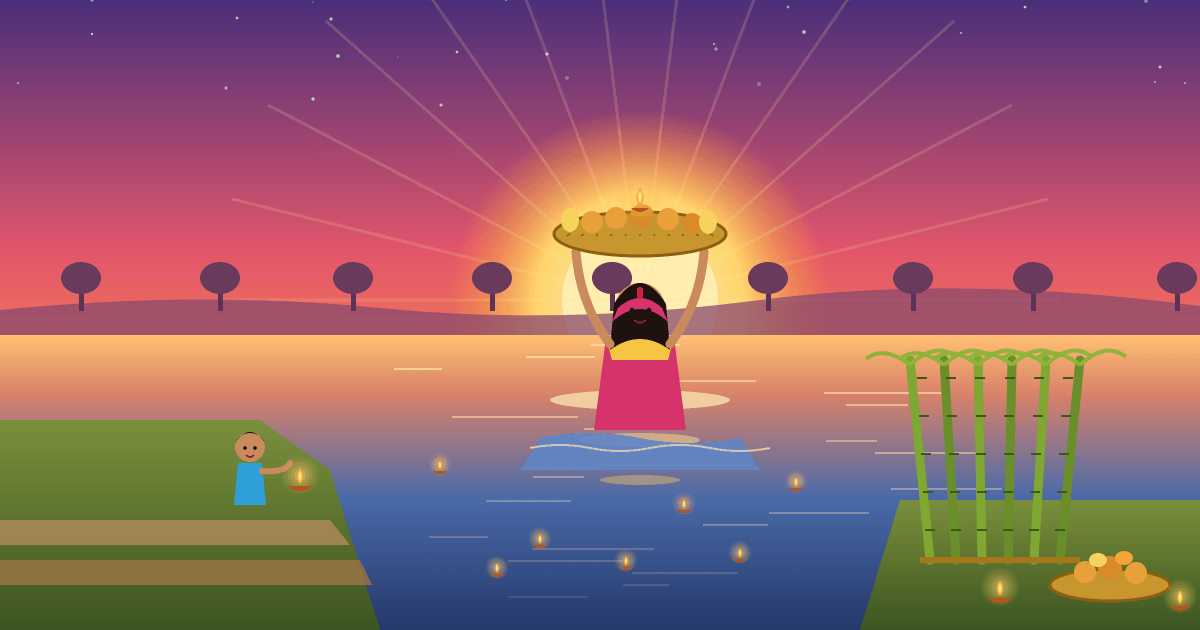
Every November, riverbanks across Bihar, Jharkhand, eastern Uttar Pradesh and Nepal glow with lamps and bamboo trays, and families stand in the water to greet the Sun. Children ask the obvious question: who started this, and why do we thank the Sun and a goddess called Chhathi Maiya? The best-known answer is the story of King Priyavrat and Queen Malini. They longed for a child, and when their baby was born without waking, the goddess Chhathi Maiya appeared, said she protects all the children of the world, and blessed the baby so that he came to life. The grateful king began to worship her, and people say this is how Chhath began.
Below is a gentle retelling for children aged about 4 to 10. It takes around five minutes to read aloud. After it you will find the other tales told about Chhath, what happens on each of the four days, the 2026 dates and some questions to ask at the end. Chhath comes a few days after Diwali, so you may like to read it after the Diwali story of Rama’s return, the Govardhan story and the Bhai Dooj story.
The King Who Sat by the River: a Chhath Puja story for kids
Long, long ago there lived a king called Priyavrat. He had a big palace with a hundred windows, gardens full of mango trees and a kitchen that smelled of ghee and cardamom from morning to night. His queen, Malini, was kind and gentle, and the people of the kingdom loved them both.
But the palace had one quiet corner. There was no little pair of feet running along the corridors, and no small voice calling “Maa!” from the garden. The king and queen had everything they could wish for, except a child.
One day the wise sage Kashyap came to the palace. The king bowed and said, “Maharaj, we have lamps and gold and horses, but our home is too quiet. What should we do?”
The sage smiled. “Sit down with an open heart, King Priyavrat. We shall light a sacred fire and pray together.”
For many days the sage and the king sat by the fire, and the queen offered the sweet kheer that was prepared as an offering. Soon the palace was full of news. The queen was going to have a baby!
The whole kingdom waited. The cooks made laddoos. The gardeners hung marigolds on every gate. The little girls of the town practised a lullaby.
But when the baby came, the room was strangely still. He was small and beautiful, but he did not open his eyes and he did not cry. The palace fell silent, too. The king took his baby in his arms, walked out of the palace, past the garden, past the mango trees, all the way to the quiet bank of the river, and sat down on the cool sand. The tears ran down his face and dropped onto the baby’s blanket.
“Oh, I wished so hard,” whispered the king. “I wished and prayed. Please, please, somebody help.”
The sky was beginning to turn orange, as it does when the Sun is about to say goodnight. Just then, a soft light began to shine above the water. It grew brighter and brighter, and from the middle of the light a lady appeared. She was calm, kind and glowing, like the warm light before sunrise.
“Do not be afraid, King Priyavrat,” she said in a voice as soft as a feather. “I am Chhathi Maiya, the sixth form of Prakriti, of Mother Nature herself. I watch over all the children of the world. Anyone who is sad because they long for a child may pray to me, and I listen.”
The king folded his hands. He could not speak.
Chhathi Maiya bent down and touched the baby gently on the forehead. For a moment nothing happened, and the whole river seemed to hold its breath. Then the baby moved his tiny fingers, opened his eyes and gave a big, loud, wonderful cry.
The king laughed and cried at the same time. “Thank you, Maiya! Thank you! How can I ever repay you?”
The goddess smiled. “Be good to all children, king, and remember to say thank you. Worship me on the sixth day of the bright half of Kartika, and when you do, thank the Sun too. He gives light and life to everyone, every single day, and he never asks for anything in return.”
And she faded into the light, like mist at sunrise.
King Priyavrat carried his baby home, and the palace burst into song. The cooks made laddoos again. The little girls sang their lullaby. The queen held her son and could not stop smiling.
From that year on, on the sixth day after Diwali, the king and queen went down to the river with the whole kingdom. They carried baskets of sweets and fruit and a bundle of sugarcane. They stood in the cool water, and when the Sun came up, golden and round, they raised their hands and said, “Thank you, Surya Dev. Thank you, Chhathi Maiya.”
People who watched did the same, and then their children and grandchildren did too. And that is why, even today, the riverbanks fill with lamps every year, and families stand together in the water to say thank you.
This is an original retelling of a traditional story. In some versions, the king takes the baby to a burial ground before the goddess appears; here we have kept to the gentle version for young children.
Other stories told about Chhath
Chhath is a folk festival, which means it has been passed down in families for a very long time and many tales have grown around it. Like most festival stories, the details vary by region and family. Here are the ones you are most likely to hear.
- Sita and Rama. One tradition says that when Rama and Sita returned to Ayodhya after exile, Sita fasted and worshipped the Sun on the sixth day after Deepavali. In Munger in Bihar, a temple called Sita Charan on a rock in the Ganga is linked with this belief.
- Kunti, Karna and Draupadi. In the Mahabharata, Karna is the son of the Sun God and Kunti, and is famous for praying to the Sun while standing in the river. Some traditions say Kunti and, later, Draupadi worshipped the Sun with the same vow.
- Surya’s birthday. Others say the sixth day of Kartika is the day Aditi gave birth to Surya, which is why he is also called Aditya, and so Chhath is celebrated as his birth anniversary.
The Brahma Vaivarta Purana mentions Chhathi Maiya, and the story of King Priyavrat is usually traced to Puranic tradition. It is a good idea to tell your child that these are traditional tales that different families tell in different ways, and that it is fine to ask elders how they tell it at home.
The four days of Chhath, in kid-friendly words
- Day 1: Nahay Khay (bathe and eat). The person keeping the vrata, called the parvaitin, takes a holy bath, the house and the path to the river are cleaned, and a simple meal of lauki (bottle gourd) with chana dal and rice is cooked and eaten. It is the start of the festival.
- Day 2: Kharna. The parvaitin fasts all day, without even water, and in the evening eats kheer made with jaggery (rasiao) and roti. After that comes a long fast.
- Day 3: Sandhya Arghya (evening offering). Families prepare prasad, including thekua, rice laddoos, sugarcane and fruit, and place it in bamboo baskets. At sunset the whole family goes to a river, pond or tank, and the parvaitin stands in the water and offers arghya to the setting Sun.
- Day 4: Usha Arghya (morning offering). Before sunrise, everyone returns to the water to greet the rising Sun. After the prayers the parvaitin ends the fast with a little prasad and water, which is called parana.
The food is strictly vegetarian and cooked without onion, garlic or salt in the prasad, and the stress is on cleanliness. The star of the basket is the thekua, a crunchy sweet made of wheat flour, jaggery and ghee, which children usually love.
A safety note for parents: ghats get crowded and the water can be cold and deep near the steps. Keep young children close, hold hands near the water, and don’t let them go in unless an adult is right beside them.
What the story means for children
- Say thank you. The king’s first thought when his child is saved is gratitude, and the goddess asks him to thank the Sun too. Chhath is, at heart, a festival of thank-yous.
- The Sun works for everyone. The Sun shines on rich and poor, on palace and hut. In Chhath, people from every background stand in the same water at the same hour.
- Sad moments can turn. The king sits at the riverbank in tears, and help arrives. It is a gentle way to talk about hoping when things feel heavy.
- Waiting and effort matter. The long fast and early mornings show how much love goes into the festival, and children can learn from the care of the elders around them.
- Nature is something to respect. Chhathi Maiya is called a form of Nature, and many families today clean the ghat and avoid plastic to keep the water clean.
When is Chhath Puja in 2026?
Chhath is held on the sixth day (Shashthi) of the bright half of Kartika, a few days after Diwali. Drik Panchang lists Chhath Puja, with Sandhya Arghya, on Sunday 15 November 2026 for New Delhi. The sunset that day is at 5:28 PM, and the sunrise for the morning offering on Monday 16 November is shortly before 6:45 AM. The other dates are:
- Nahay Khay: Friday 13 November 2026
- Kharna: Saturday 14 November 2026
- Sandhya Arghya (Chhath Puja): Sunday 15 November 2026
- Usha Arghya and parana: Monday 16 November 2026
Times vary from city to city, so check a local panchang or your temple calendar, especially if you live outside India. This year the festival also follows Bhai Dooj on Wednesday 11 November, so the stories of the whole Diwali week, from Dhanteras to Narakasura, make a nice reading series.
How to tell this story to young children
- Make a mini ghat. Put a shallow tray of water on the table with a few floating flowers, and let your child sit beside it while you tell the story. The river is a big part of the tale.
- Use a soft voice for the goddess. Say Chhathi Maiya’s lines slowly and kindly, almost whispering, and let your child say the first “Thank you!” with you.
- Keep the sad part short. For children under six, say that the baby was sleeping very deeply and did not wake up until Chhathi Maiya touched him. You can tell the fuller version when they are older.
- Pause at the sunrise. Stop when the Sun comes up and ask your child what they would say to the Sun. Their thank-yous are often the best part.
- Make thekua together. A small, simple jaggery-and-wheat sweet in the kitchen makes the festival real. Our guide on how to tell stories to kids without a book has voice and pause tips, and kids who want the same tale again and again are normal, as we explain in why kids ask for the same bedtime story.
Questions to ask after the story
- How did the king feel when he sat on the riverbank? How did he feel when the baby cried?
- Why do you think Chhathi Maiya asked the king to thank the Sun as well?
- What do you see the Sun do for us every day?
- Who would you like to say thank you to this week, and how?
- If you were making a basket for the Sun, what would you put in it?
Asking questions like these is called dialogic reading, and our guide to dialogic reading at home has more ideas. For more tales about gratitude and patience, try The Empty Pot, the best Panchatantra stories for kids or our moral stories for children.
Frequently asked questions
What is the story behind Chhath Puja?
One well-known legend is about King Priyavrat and Queen Malini, who had no child. After a prayer ritual a son was born, but he did not wake up, and the king sat by him in tears. The goddess Shashthi, also called Chhathi Maiya, appeared, said she protects all the children of the world, and blessed the baby so that he came to life. The grateful king began to worship her, and people say this is how Chhath started. Other traditions link the festival with Sita, Kunti, Draupadi and Karna.
Who is Chhathi Maiya?
Chhathi Maiya (also Chhathi Mata or Shashthi Devi) is the goddess who is believed to protect children and give them long, healthy lives. Wikipedia describes her as the sixth form of Prakriti (Nature) and Surya’s sister. She is worshipped alongside the Sun God on the sixth day of the bright half of Kartika.
When is Chhath Puja in 2026?
Drik Panchang lists Chhath Puja (Sandhya Arghya) on Sunday 15 November 2026 for New Delhi. Nahay Khay is on Friday 13 November, Kharna on Saturday 14 November, and Usha Arghya with the parana on Monday 16 November. Local sunset and sunrise times differ, so check a panchang for your city.
Why do people stand in water during Chhath?
Devotees stand in a river, pond or tank and offer arghya (water and offerings) to the setting sun on the third day and the rising sun on the fourth day. It is a way of saying thank you to the Sun, who gives light and life. Where there is no river, families use a tank or a safe indoor set-up.
How can I explain Chhath to a small child?
Say that Chhath is a festival of thank you to the Sun and to Chhathi Maiya, who looks after children. Family members clean the house, make special sweets like thekua, go to the water at sunset and sunrise, and say thanks together. Then tell the story of King Priyavrat.
Sources
- Wikipedia. Chhath (the four days, food and offerings, the Sita, Kunti, Draupadi and Priyavrat legends, Brahma Vaivarta Purana, Munger and the Sita Charan temple).
- Drik Panchang. Chhath Puja 2026 date and timings and Chhath Puja 2026 calendar (New Delhi).
The King Who Sat by the River is an original retelling written by the BestStories Editorial Desk. You are welcome to read it aloud at home or in class.