Why Kids Want the Same Bedtime Story Again (and Why It Helps)
You close the book, and before you can say goodnight a small hand pushes it back. “Again.” You offer a new story. “No. This one.” If that happens in your home every night, you are in very good company, and you are not doing anything wrong. Children ask for the same bedtime story because a familiar story feels safe and predictable, and because each re-read lets them notice something they missed before. A small but careful study even found that hearing the same story again helped three-year-olds learn new words better than hearing different stories.
Below you will find what that research actually says (and what it does not), why repetition suits bedtime so well, a short original story written to be read again and again, and simple ways to keep the tenth reading as useful as the first. For the basics of talking about a book while you read, see our guide to dialogic reading at home.
What the research found
In 2011, psychologist Jessica Horst and her colleagues Kelly Parsons and Natasha Bryan at the University of Sussex tested this question directly. They wrote special storybooks, each containing two made-up names for unusual objects, and read them to three-year-olds at home three times over one week.
One group heard the same story at every session. The other group heard three different stories that used the same new words. This detail matters: both groups heard each new word exactly the same number of times. The only difference was whether the story around the word stayed the same.
The children who heard the same story were very accurate when tested straight away and again a week later. The children who heard different stories did well only on the immediate tests in the later sessions and did not retain the new words. The researchers linked the effect to contextual repetition: when the story is familiar, the child has more attention left over for the new word.
It is worth being honest about the limits. This was a small experiment with sixteen children, using specially written books. It did not test bedtime reading in particular, and it did not ask why children request their favourites. It does, however, give parents a good reason to stop worrying that the fortieth reading of the same book is a waste of time.
Why a familiar story fits bedtime
The study explains the learning. Daily life explains the request. A few reasons usually work together:
- Predictability is calming. At the end of a long day, a story whose ending is already known asks nothing new of a tired brain. Knowing that the lost puppy always gets home is a small, reliable comfort before the lights go out.
- Mastery feels good. When a child can say the next line before you do, they get to be the expert. Many children start “reading” a favourite book aloud from memory long before they can decode a single word.
- There is always more to notice. The first time through, a child follows the plot. Later readings free them to look at the pictures, the funny sound words and the side characters.
- The ritual is part of the comfort. Same pyjamas, same pillow, same story. For many children the routine around the book matters as much as the book itself, especially during changes such as a new school, a new sibling or travel.
A story made for reading again: The Little Paper Boat
This short original story is built for repeat readings. It has a refrain your child can join in on, a clear pattern and one new word in each scene to discover over several nights. It takes about two minutes to read aloud.
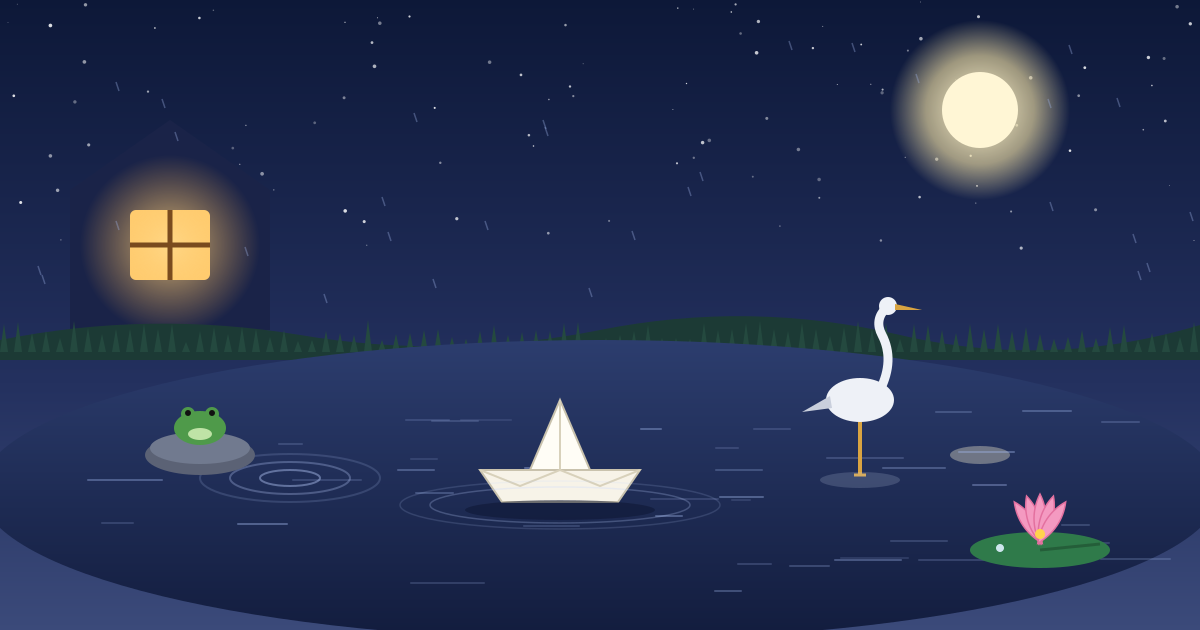
It rained all afternoon, and when the rain stopped, Anu folded a paper boat.
She set it on the big puddle by the gate and gave it a tiny push.
Float, little boat, float slow,
Tell me where the raindrops go.
The boat floated past a frog sitting on a stone. The frog puffed out its throat and said, “Croak.” The water made a small ripple, round and round, where the frog had jumped.
Float, little boat, float slow,
Tell me where the raindrops go.
The boat floated past a tall white bird standing on one thin leg. It was a heron, and it did not move at all, not even when the boat bumped its toes.
Float, little boat, float slow,
Tell me where the raindrops go.
The boat floated past a flower as pink as Anu’s slippers, sitting on a big flat leaf. It was a lotus, and a drop of rain was resting in the middle of the leaf like a tiny mirror.
Float, little boat, float slow,
Tell me where the raindrops go.
Then the puddle grew still. The frog was quiet. The heron closed its eyes. The lotus folded its petals for the night.
Anu lifted her paper boat, damp and soft, and carried it inside.
“Where do the raindrops go?” she asked her mother.
“Some go into the river,” said Amma. “Some go back up to the sky. And some,” she said, tucking the blanket under Anu’s chin, “stay in the puddle and sleep, just like you.”
Float, little boat, float slow,
Now it’s time for me to go.
Goodnight.
How to use it over a week
- Night 1: just read it, slowly, and let the new words land without explaining them.
- Night 2: pause before the refrain and let your child say it.
- Night 3: stop at each scene and ask, “What did the boat float past?” Accept “a bird” and answer, “Yes, a tall bird called a heron.”
- Night 4 and after: let your child tell one scene. Many children will start adding their own animals. That is a good sign, not a mistake.
How to make the re-read count
You do not need to turn bedtime into a lesson. Small changes, one per night at most, are enough:
- Leave a gap. Stop just before a familiar word or rhyme and let your child fill it in. This turns listening into speaking without any pressure.
- Ask about one picture, not every page. “What is the bird doing?” is plenty. If your child gives a simpler word, repeat theirs and add the new one.
- Keep the words the same. It is tempting to paraphrase when you are bored, but the study’s point is that the familiar context helps. Children will often correct you if you change a line, and they are right to.
- Swap roles sometimes. Let your child “read” the book to you or to a soft toy. Telling a story from memory is real language practice.
- Add variety elsewhere. Keep the favourite for bedtime and bring new books, library visits and oral stories into the daytime. Our guide to telling stories without a book has ideas you can use on car rides and walks.
When you are tired of the same book
It is perfectly fine to admit that you are bored. A few honest compromises that keep everyone happy:
- Offer a deal: “Your favourite first, then one new short one.” Our short bedtime stories for toddlers are quick enough to fit as the second story.
- Try a new story with a similar shape. A child who loves a gentle, repeating story may happily accept another one, such as The Lantern That Waited.
- Let another adult take a turn with the favourite. A new voice can make an old book feel fresh again.
- Use the time well: read slowly, notice the pictures yourself and treat it as two quiet minutes together at the end of the day.
If a child seems unusually distressed by any change at all, or the need for sameness is getting in the way of daily life, it is reasonable to mention it to your paediatrician. For most children, though, asking for the same story is simply a healthy part of growing up with books.
Frequently asked questions
Why does my child want the same bedtime story every night?
A familiar story is predictable and safe, which suits the end of a busy day, and young children enjoy knowing what comes next. Research has not pinned down every child’s reason, but it does show that hearing the same story again can help children learn the new words inside it.
Is it bad to read the same book over and over?
No. In the 2011 Sussex study, three-year-olds who heard the same story three times remembered new words better than children who heard three different stories with the same words. Keep the favourite and add variety at other times of the day.
How many times should I read the same story?
There is no magic number. Let your child lead while the story still holds their attention, and try one small change each time, such as pausing for them to finish a line or asking about one picture.
At what age do children stop asking for the same story?
It is most common in the toddler and preschool years. Many older children still return to an old favourite when they are tired, unwell or facing a change, and that is normal too.
Sources
- Horst, J. S., Parsons, K. L. and Bryan, N. M. (2011). Get the Story Straight: Contextual Repetition Promotes Word Learning from Storybooks. Frontiers in Psychology, 2:17.
- The Economic Times (14 October 2026). A study says if your kid keeps asking for the same bedtime story again, they may be learning more than you realise.
The Little Paper Boat is an original story written by the BestStories Editorial Desk. You are welcome to read it aloud at home or in class.