Dialogic Reading at Home: How to Turn Story Time Into a Conversation
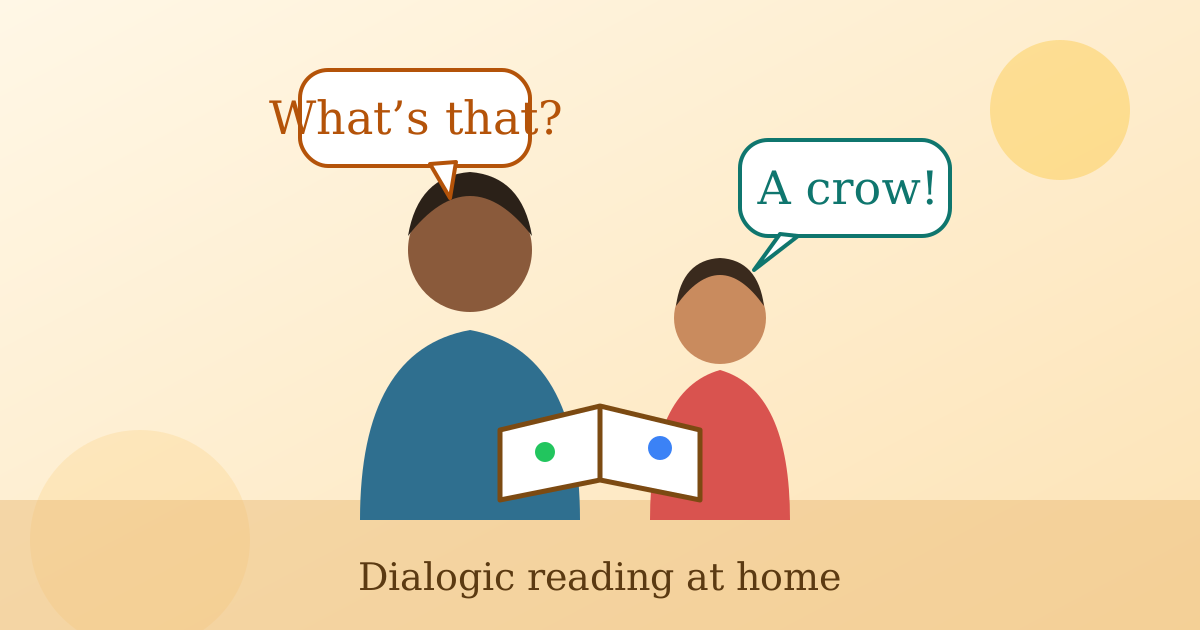
Most of us read to children the way we were read to: the adult holds the book, reads every word, turns the page, and the child listens. But there is another way to share a story that turns a quiet listener into an active storyteller, and it needs no special books or apps.
The method is called dialogic reading. It was developed by psychologist Grover J. (Russ) Whitehurst and colleagues at the Stony Brook Reading and Language Project, and the idea behind it is simple. In Whitehurst's words, the adult helps the child become the teller of the story, while the adult becomes "the listener, the questioner, the audience." Below you will find how it works, which questions suit which ages, a worked example using a tale your child may already know, and the mistakes that make it feel like a quiz instead of a conversation.
Why the way you read matters, not just how often
In 2024 the American Academy of Pediatrics (AAP) published an updated policy statement, Literacy Promotion: An Essential Component of Primary Care Pediatric Practice, the first revision of its recommendations since 2014. It encourages shared reading from birth through at least kindergarten. Just as important is the word it keeps returning to: interaction. In the AAP's summary for parents on HealthyChildren.org, pediatricians are asked to encourage "meaningful, language-rich engagement with books, pictures and the written word" and to model positive shared-reading techniques.
Dialogic reading is one of the best-known of those techniques. Whitehurst's own explanation of the method on Reading Rockets reports that children read to this way came out substantially ahead on language tests compared with children read to in the traditional way, with gains showing up after just a few weeks. You do not need to chase test scores to benefit, though. The everyday payoff is a child who talks more, notices more and starts to treat stories as something they can take part in.
The PEER sequence: one small loop, repeated
The core of dialogic reading is a short exchange called PEER. On a single page you:
- Prompt your child to say something about the book.
- Evaluate the answer, which usually just means a warm "yes" or a gentle correction.
- Expand on what they said by rephrasing it and adding a little more information.
- Repeat the prompt so your child gets to try the fuller version.
Here is how that sounds with a picture of a thirsty crow beside a tall jug:
Parent: "What is the crow looking at?" (prompt)
Child: "Water."
Parent: "Yes, water (evaluate). The water is right at the bottom of a tall pitcher, and the crow can't reach it (expand). What is the crow looking at?" (repeat)
Child: "Water in the tall pitcher!"
That is the whole loop, and it takes about fifteen seconds. Whitehurst suggests that once a book is familiar, a PEER exchange can happen on nearly every page, and that each time you reread a book you can read fewer of the printed words yourself and leave more of the telling to your child. On the very first reading, simply enjoy the story together.
CROWD: five kinds of questions to start the loop
The "prompt" in PEER can take five forms, remembered with the word CROWD.
Completion prompts
Pause before the end of a sentence and let your child fill the gap: "The crow dropped in one more ..." ("pebble!"). These work best with rhyming or repetitive text, and they are perfect for toddlers who love to shout the predictable word.
Recall prompts
Ask what happened earlier: "Do you remember why the crow couldn't drink at first?" Recall prompts help children understand plot and the order of events. They work well at the end of a story, or at the start of a book you have read before.
Open-ended prompts
Invite description without a single right answer: "Tell me what is happening in this picture." These suit books with detailed illustrations and encourage longer, more fluent answers.
Wh- prompts
Questions beginning with what, where, when, why and how: "What is this called?" while pointing to the pitcher. These are the quickest way to build vocabulary, especially for words your child does not use yet.
Distancing prompts
Connect the story to your child's own life: "Remember when you couldn't reach the tap and you stood on the step stool? How is that like the crow?" These build a bridge between books and the real world.
Which questions suit which age
Not every prompt fits every child. Whitehurst notes that recall and distancing prompts are harder than completion, open-ended and wh- prompts, and recommends saving frequent use of them for four- and five-year-olds. A practical way to think about it:
- Around 2 to 3 years: lean on wh- questions about the pictures ("What's that?", "Where is the mouse?") and completion prompts in rhyming or repetitive books. Keep expansions small, adding one or two words to what your child says.
- Around 4 to 5 years: add recall ("What did the monkey do when he found out the crocodile's plan?") and distancing prompts ("Have you ever had to think fast like that?"). Open-ended prompts can now produce whole little stories.
- Six and up: the CROWD prompts still work, but the conversation naturally shifts toward motives and choices. Fables are ideal here because the moral invites a real debate. Our guide to Aesop's fables and their moral lessons suggests which fables suit different ages.
A worked example with a Panchatantra tale
Dialogic reading is usually described with picture books, but it works just as well with the short folk tales and fables you can read here on BestStories, because they have clear turning points that make natural places to pause. Take The Monkey and the Crocodile, the Panchatantra story of a monkey who befriends a crocodile and then has to think quickly when the friendship turns dangerous. With a four-year-old, a second or third reading might go like this:
- Before the story (recall): "Who were the two friends in this story?"
- At the friendship scene (wh-): "What did the monkey give the crocodile from the tree?" Then expand: "Yes, fruit. Sweet fruit from the tree by the river."
- At the turning point (open-ended): stop just before the monkey answers the crocodile in the middle of the river. "What do you think the monkey is feeling right now?"
- After the clever escape (distancing): "The monkey stayed calm and used his brain. When did you have to stay calm when something went wrong?"
Notice that there are only four prompts across the whole story. That is plenty. The rest of the time, you read and enjoy it together. If your child prefers animal fables, The Crow and the Pitcher and The Lion and the Mouse are both short enough to reread several nights in a row, which is exactly what dialogic reading needs. For more options, browse the Panchatantra collection or the full story library.
Common mistakes that turn reading into a quiz
Too many questions. Whitehurst's advice is to keep it light and not push children with more prompts than they can happily handle. If your child starts wriggling or says "just read it", drop back to straight reading. You can always prompt next time.
Correcting too hard. The "evaluate" step is meant to be encouraging. If your child calls the crocodile a lizard, try: "It does look like a lizard! It's a crocodile, a much bigger animal that lives in rivers." You have corrected and expanded in one warm sentence.
Skipping the expansion. The expansion is where new words and longer sentences come from. A bare "good job" misses the most useful part of the loop.
Only using brand-new books. Dialogic reading shines on rereads. When a child already knows the story, they have the confidence to tell it back. Rereading the same tale every night for a week is not a rut. It is the method working.
Saving it for the last minutes before sleep. A lively question-and-answer session can wake a child up. Many families find it works better earlier in the evening or on a weekend morning, keeping the final story of the night calm and quiet. Our short bedtime stories for toddlers are written for that wind-down moment.
What about e-books and audiobooks?
The AAP's guidance puts the emphasis on print books for young children, noting that digital books do not create the same back-and-forth between parent and child. It does not rule screens out entirely: if you use a screen-based book or an audiobook, the AAP recommends talking with your child about it as you go. In practice, CROWD prompts still apply. Pause the narration, ask what just happened, and let your child answer before pressing play again.
A five-minute way to start tonight
- Pick a story your child already knows and likes.
- Read it through once as you normally would.
- On the second read, choose three pages and ask one wh- question on each.
- Whatever your child says, add a few words to it and invite them to say it again.
- Stop while it is still fun.
That is it. Over a few weeks you will probably notice yourself reading less and listening more, and that is the point.
Frequently asked questions
What age should I start dialogic reading?
The prompts suit children from roughly two years old, once they can name a few things in pictures. Before that, simply reading aloud, pointing and naming things is the best start, and the AAP encourages shared reading from birth.
How many questions should I ask per book?
Fewer than you think. On a first read, none at all. On rereads, a handful of short exchanges is plenty, and you should stop as soon as your child seems restless.
Does dialogic reading work with older children?
Yes, though the questions change. With school-age children the conversation moves toward why characters act as they do and whether the moral of a fable is fair, which builds comprehension and reasoning.
Can I use dialogic reading in languages other than English?
Yes. The method is built on conversation, not on any particular language, so the PEER and CROWD steps work the same way in Malayalam, Hindi, Arabic or any other home language. Use whichever language you speak most comfortably and expressively with your child.
Is dialogic reading the same as asking comprehension questions?
Not quite. Comprehension questions check whether a child understood. Dialogic reading uses questions to start a conversation, then builds on the child's answer with an expansion so they hear and try out richer language.