Narakasura Story for Kids: How Krishna and Satyabhama Brought the Deepavali Dawn
In much of South India, and in Goa, Deepavali does not start in the evening. It starts in the dark before sunrise, with a warm oil bath, new clothes and the first lamps of the festival. Children who are woken that early usually ask the same thing: why? The answer is a story. The Narakasura story tells how Krishna and his queen Satyabhama defeated Naraka, a proud king who stole from the gods and locked up thousands of people. As he fell, Naraka asked to be remembered with light, and so the day called Naraka Chaturdashi begins Deepavali with lamps at dawn.
Below is a gentle retelling written for children aged about 4 to 10. It takes around four minutes to read aloud. After it you will find where the story comes from, what it means, how families celebrate the day and a few questions to ask once the story ends. If you are looking for the story of Rama coming home to Ayodhya, read our Diwali story for kids in English first. The two stories sit side by side in the festival.
The King Who Wanted Everything: a Narakasura story for kids
Long ago, in a kingdom called Pragjyotisha, where a wide river ran between green hills, there lived a king named Naraka.
Naraka was the son of Bhumi Devi, Mother Earth herself. When he was a baby, his mother asked for a gift for him: that he would be strong and live a long, long life. The gift was given. Naraka grew up so strong that no army could stand against him.
But as he grew stronger, Naraka forgot how to be kind. Being strong was not enough for him. He wanted everything. When he marched through his fort, he sang:
“Mine, mine, all of it mine!
Every jewel and every shine!”
He took the great shining umbrella of Varuna, the lord of the oceans. He took the beautiful earrings of Aditi, the mother of the gods. He took over the mountain garden where the gods liked to rest. And worst of all, he locked thousands of people inside his fort, princesses and ordinary people alike, and would not let them go home to their families.
At last Indra, the king of the gods, went to the city of Dwaraka beside the sea, where Krishna lived. “Naraka has taken what is not his,” Indra said. “Please, will you help?”
Krishna listened carefully. Next to him sat Queen Satyabhama, who was famous for two things: she was very brave, and she always said exactly what she thought.
“Aditi’s earrings? People locked away from their mothers and fathers?” said Satyabhama. “That is not right. I am coming too.”
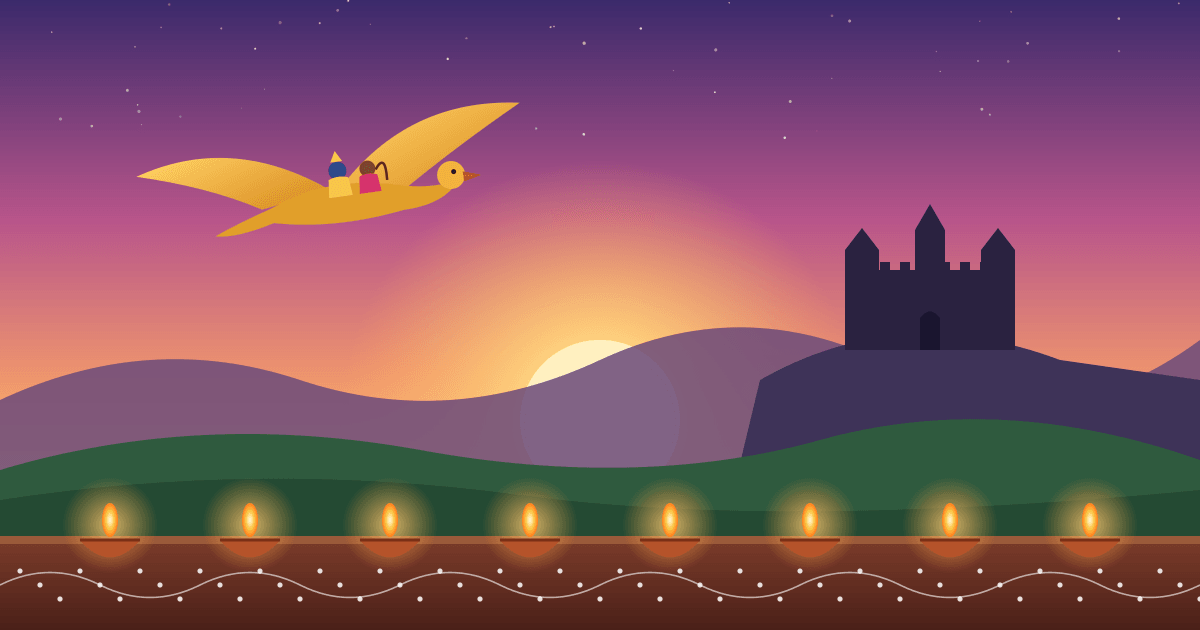
So Krishna called Garuda, the great golden eagle. Krishna and Satyabhama climbed onto his back, and whoosh, up they went, over forests and rivers and fields, until they saw Naraka’s fort far below. It was ringed by mountains, by deep water, by fire and by walls of rushing wind.
Krishna lifted his conch shell and blew. The sound rolled over the hills like thunder, and one by one the walls around the fort gave way. Naraka’s general, Mura, rushed out to stop them, but Mura was beaten. That is why, even today, one of Krishna’s names is Murari, “the one who defeated Mura”.
Then Naraka himself came thundering out on a huge elephant.
“Mine, mine, all of it mine!” he roared, and he threw his mighty spear. But the spear fell to the ground and did no harm at all.
Now, here is a secret that grandmothers in many South Indian homes like to whisper at this point. Long ago, when Bhumi Devi asked for her son’s gift, there was one condition: Naraka could only be defeated by his own mother. And Satyabhama, the storytellers say, was Bhumi Devi born again.
In the middle of the battle, Krishna sank down as if he were tired. Satyabhama did not wait. She picked up his bow, took a slow, steady breath, aimed and let the arrow fly. Naraka tumbled from his elephant, and all his great strength drained away like water from a cracked pot.
Lying on the ground, Naraka looked up at Satyabhama, and suddenly he understood. “I took and took,” he said quietly, “and I never thought about anyone else. I made the world dark.”
Then he asked for one last thing. “Let people remember this day, not with sadness, but with light. Let them wake early, wash, put on new clothes and light lamps in every doorway, as if all the darkness I made has been washed away.”
“So it will be,” said Satyabhama.
Then the gates of the fort swung open. Thousands of people walked out, blinking in the sunshine, and hurried home to their families. Bhumi Devi came forward, sad but calm, and gave back everything her son had taken. With her was Naraka’s young son, Bhagadatta, who was very frightened. Krishna knelt down, spoke kindly to the boy and made him the new king.
Varuna got his umbrella back. And Krishna and Satyabhama flew all the way up to the home of the gods to return Aditi’s earrings to her themselves.
And that is why, every year on Naraka Chaturdashi, children wake while the sky is still dark. They have a warm bath, put on new clothes and light a little lamp at the door. And somewhere a grandmother sings the other song, the one Naraka learned too late:
“Light, light, a lamp for you,
A lamp for me and a lamp for you.”
Where the Narakasura story comes from
Naraka and his kingdom of Pragjyotisha are mentioned in the Mahabharata, and the fullest classic account of his defeat is in chapter 59 of the tenth book of the Bhagavata Purana. There, Indra asks Krishna for help after Naraka steals Varuna’s umbrella and Aditi’s earrings; Krishna flies to Pragjyotisha on Garuda with Satyabhama, breaks through the fort’s defences, defeats Mura and then Naraka, frees the prisoners and makes Naraka’s son king after Bhumi Devi returns the stolen treasures.
In that text it is Krishna who strikes the final blow. The detail that only Naraka’s mother could defeat him, and that Satyabhama was Bhumi Devi reborn, comes from later retellings and is the version many families in South India grow up with. So is Naraka’s last wish to be remembered with lights. Neither version is “wrong”; they are simply different ways the story has been told. Pragjyotisha is traditionally linked with ancient Assam, and a hill near Guwahati still carries Naraka’s name.
What the story means for children
- Strength is not the same as goodness. Naraka was given a great gift, but he used it to grab things. Children understand this quickly: being the biggest or strongest does not make you right.
- Brave people speak up. Satyabhama hears about something unfair and says so at once. It is a good moment to talk about standing up for others.
- It is never too late to say sorry. Naraka realises what he has done, and his last wish is for something good for everyone. Many families like ending on that note.
- Kindness after a quarrel. Krishna comforts Naraka’s frightened son and makes him king instead of punishing him. The story does not end in anger.
How families celebrate Naraka Chaturdashi
The day is also called Choti Diwali in many parts of North India. In Tamil Nadu, Karnataka, Andhra Pradesh, Telangana and Kerala, it is often the main day of Deepavali. Families rise before dawn for an abhyanga snan, an oil bath, often with oil massaged into the hair by a parent or grandparent. New clothes, sweets, lamps at the door and the first crackers follow, all before or around sunrise.
Goa has its own spectacular version. In the weeks before the festival, neighbourhoods build giant, colourful effigies of Narakasura. On the night before Naraka Chaturdashi they are paraded through the streets, and they are burned just before dawn, a very visible way of saying that the darkness is gone.
Dates for 2026: the Chaturdashi tithi runs from late morning on Saturday 7 November to late morning on Sunday 8 November (Indian time). Many Indian panchangs therefore place the dawn oil bath on Sunday 8 November 2026, the same day as Lakshmi Puja, while Choti Diwali lamps are lit on the evening of Saturday 7 November. Regional calendars differ a little, so check your local panchang or temple calendar, especially if you live outside India.
How to tell this story to young children
- Choose your version by age. For children under five, skip the battle. Naraka takes things, Satyabhama says “That is not right”, the gates open and everyone lights lamps. For older children, include Mura, the elephant and the secret about Bhumi Devi.
- Let them join in. The two little rhymes are there on purpose. Say “Mine, mine, all of it mine!” in a grumpy voice and let your child shout it with you; then whisper the lamp song at the end. Our guide on how to tell stories to kids without a book explains why repeated lines work so well.
- Use the morning. If your family does the dawn oil bath, tell the story the night before and remind them of it as they light their lamp. The ritual makes far more sense to a child who knows why.
- Make Satyabhama the hero. Children rarely hear stories where a queen picks up the bow. Let her be as brave and loud as she likes.
Questions to ask after the story
- Why do you think Naraka kept wanting more and more things?
- What would you have said to Naraka if you had been there?
- Why did Satyabhama decide to go with Krishna?
- Was it kind of Krishna to make Naraka’s son the king? Why?
- If you could light a lamp for one person this Deepavali, who would it be for?
Talking about a story like this is called dialogic reading, and our article on dialogic reading at home has more easy question ideas. For more stories from Indian tradition, try our picks of the best Panchatantra stories for kids and Jataka tales for kids.
Frequently asked questions
What is the Narakasura story in short?
Narakasura was a strong king, the son of Bhumi Devi (Mother Earth), who grew proud, stole treasures from the gods and locked up thousands of people. Krishna and his queen Satyabhama flew to his fort on Garuda and defeated him. In the popular telling, Naraka asked to be remembered with lamps, which is why Naraka Chaturdashi begins Deepavali with lights.
Who killed Narakasura, Krishna or Satyabhama?
Both versions are told. In the Bhagavata Purana, Krishna defeats Naraka himself, with Satyabhama beside him. In the version many South Indian families tell, Naraka could only be defeated by his own mother, so Satyabhama, believed to be Bhumi Devi reborn, shoots the final arrow.
When is Naraka Chaturdashi in 2026?
In 2026 the Chaturdashi tithi runs from late morning on Saturday 7 November to late morning on Sunday 8 November (IST). Many Indian panchangs place the dawn oil bath on Sunday 8 November, the same day as Lakshmi Puja, while Choti Diwali lamps are lit on the evening of 7 November. Check your local calendar.
Is the Narakasura story too violent for small children?
It does not need to be. For children under five, tell it as a story about a king who took things that were not his and the brave queen who set people free. Leave out the battle details and end with the lamps and the open prison gates.
Sources
- Bhagavata Purana, Canto 10, Chapter 59, “The Killing of the Demon Naraka” (translation and summary on Vedabase).
- Wikipedia. Narakasura (literary development of the story, the Satyabhama and Bhumi Devi tradition, Naraka Chaturdashi).
- Encyclopaedia Britannica. Diwali (updated 24 October 2026).
- AstroSage Panchang. Narak Chaturdashi 2026 date and muhurat (New Delhi).
The King Who Wanted Everything is an original retelling written by the BestStories Editorial Desk. You are welcome to read it aloud at home or in class.