Jataka Tales for Kids: 7 Stories and the Lessons They Teach
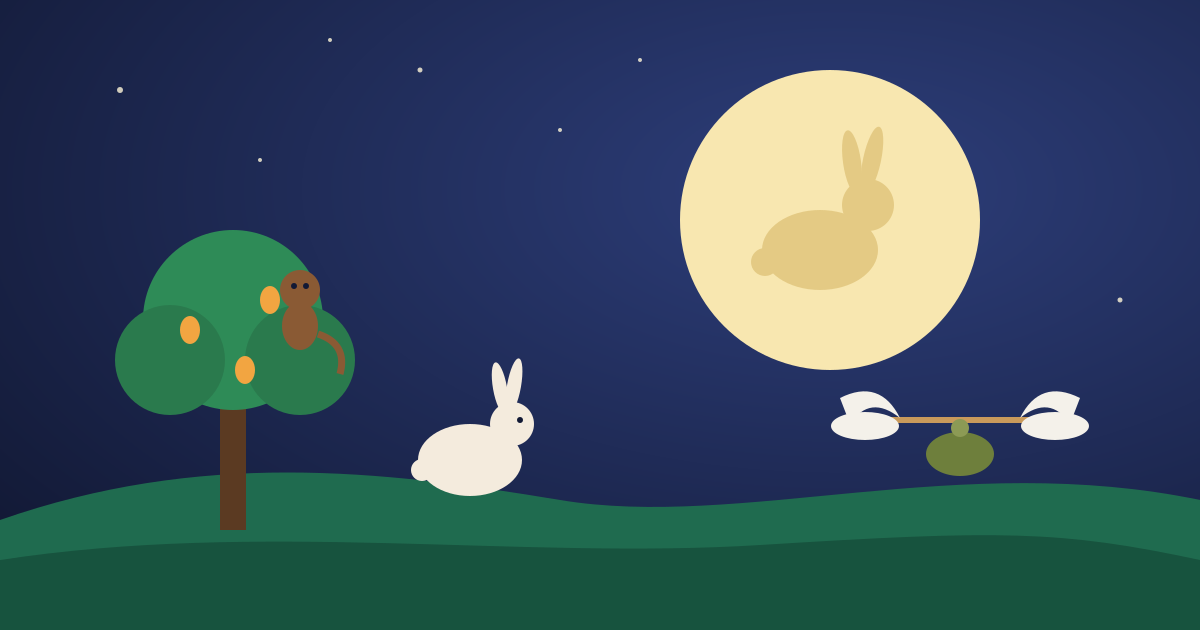
Long before bedtime story apps, children in India and across Asia were hearing about a hare who offered itself to a hungry traveller, a monkey who made a bridge with his own body, and a tortoise who could not stop talking. These are Jataka tales, and they are some of the oldest stories for children that we still tell today.
This guide explains what Jataka tales are and where they come from, then retells seven of the best-loved ones in short form, with the lesson each one carries and a question to ask your child afterwards. Each one is short enough to tell from memory.
What are Jataka tales?
The word jataka means "birth". In the Buddhist tradition, Jataka tales are stories about the earlier lives of the Buddha, before he became the Buddha. In each tale he appears as a different being, called the Bodhisatta (or Bodhisattva in Sanskrit): sometimes a king, sometimes a merchant, very often an animal such as a deer, a monkey, a hare or a swan. In every life he shows a quality worth learning, such as kindness, honesty, patience or courage.
The best-known collection is the Pali Jataka of the Theravada Buddhist tradition, which contains more than 500 stories. They were told for centuries before being written down, and scenes from them were carved on the ancient stupas at Bharhut and Sanchi and painted on the walls of the Ajanta caves. English readers came to know them largely through the translation edited by E. B. Cowell and published by Cambridge University Press between 1895 and 1907. You can find a selection from that translation, with notes, on folklorist D. L. Ashliman's Jataka Tales page at the University of Pittsburgh, and a short scholarly overview in Encyclopaedia Britannica.
If some of the stories sound familiar, that is because they travelled. A few appear in both the Jatakas and the Panchatantra, and others have cousins in Aesop's fables.
Why they work so well for children
- The heroes are animals. Children find it easy to care about a deer or a hare, and the lesson lands without a lecture.
- Goodness is active. The hero does not simply avoid doing wrong. He gives something up, takes a risk or finds a clever way to help others.
- They are built for retelling. Clear beginnings, a single problem and a memorable ending make them perfect for telling without a book. Our guide on how to tell stories to kids without a book shows you how.
Seven Jataka tales to tell your child
1. The Hare in the Moon
Four friends lived together at the edge of a forest: a hare, a monkey, a jackal and an otter. One holy day they agreed that each would give food to anyone who asked. The otter found fish, the jackal found some meat and a pot of curd, and the monkey picked ripe mangoes. But the hare only ate grass, and grass is no gift for a hungry person.
That evening an old traveller came by and asked the hare for food. The hare thought for a moment, then asked the man to build a fire. "I have nothing else to give," it said, "so I will give myself." It leapt into the flames, but the fire felt as cool as snow. The traveller was really Sakka, king of the gods, who had come to test the friends. Moved by the hare's goodness, he painted the shape of a hare on the moon, so that everyone could remember it for ever.
The lesson: real generosity means giving what you can, even when you think you have very little. Ask your child: Can you see a hare when you look at the full moon?
2. The Monkey King's Bridge
A great monkey king and his troop of eighty thousand monkeys lived in a huge mango tree beside a river. One day a human king came to the river, found the sweet mangoes and ordered his archers to surround the tree at night so the monkeys could not escape.
The monkey king leapt across the river, tied one end of a long bamboo cane to a tree on the far bank and the other end to his own waist, and jumped back. The cane was too short, so he gripped a branch and stretched his body across the gap. One by one, the whole troop ran across his back to safety. The human king watched and was ashamed. He had the brave monkey gently brought down and cared for, and he learned that a true ruler protects those in his care, whatever it costs him.
The lesson: leaders look after others before themselves. A note for parents: in the traditional telling, the monkey king is badly hurt and dies after giving the human king his advice. With younger children, many families end the story at the rescue. Ask your child: How do you think the other monkeys felt when they reached the other side?
3. The Talkative Tortoise
A tortoise who loved to talk lived in a lake with two geese. When the lake began to dry up, the geese offered to carry the tortoise to a new home. He would hold a stick in his mouth, and they would each hold one end and fly. "But you must not say a single word," they warned.
As they flew over a village, children looked up and shouted, "Look! Two geese are carrying a tortoise!" The tortoise could not bear it. He opened his mouth to reply, let go of the stick and fell to the ground.
The lesson: sometimes the wisest thing is to stay quiet. You can read our full version, The Tortoise and the Geese. Ask your child: What could the tortoise have done instead of answering?
4. The Monkey and the Crocodile
A crocodile and his wife lived in a river beside a fruit tree, where a clever monkey lived. The crocodile's wife decided that she wanted to eat the monkey's heart, so the crocodile invited the monkey for a ride on his back across the river. Halfway across, he confessed his plan.
The monkey stayed calm. "What a pity you didn't tell me," he said. "Monkeys don't carry their hearts with them. I left mine hanging in the tree." The foolish crocodile swam back to fetch it, and the monkey sprang to safety in the branches.
The lesson: keep a clear head when you are in trouble. Read our longer retelling, The Monkey and the Crocodile. Ask your child: Was the crocodile a good friend? Why not?
5. The Banyan Deer
A king loved hunting so much that his people grew tired of following him into the forest. So they built a deer park, and every day one deer was chosen to be taken for the king's kitchen. The deer were led by two kings of their own, and the Banyan Deer king was the wisest of them.
One day the lot fell on a mother deer who was about to give birth. She begged for her turn to be put off until her fawn was born. The Banyan Deer king would not send another deer in her place. Instead, he went to the block himself. When the human king heard what had happened, he was so moved that he promised the deer would never be hunted again, and then, at the deer king's request, extended that promise to every creature in his kingdom.
The lesson: one brave act of kindness can change the rules for everyone. Ask your child: Why did the deer king ask for safety for all the animals, and not just the deer?
6. The Quarrelling Quails
A huge flock of quails was being caught, one net at a time, by a bird-catcher. Their wise leader had an idea. "When the net falls on us, we will all push our heads through the holes and fly up together." It worked. The whole flock lifted the net into the air, dropped it on a thornbush and escaped. Day after day, the bird-catcher went home with nothing.
Then one morning a quail stepped on another's head by accident. "Who do you think lifts the net?" one snapped. "I do most of the work!" said the other. While they argued about who was strongest, the bird-catcher threw his net. This time nobody lifted together, and they were caught.
The lesson: together we are strong; quarrelling makes us weak. Ask your child: When does your family work best as a team?
7. The Golden Swan
A swan with golden feathers once found a poor widow and her daughters. Feeling sorry for them, it visited every few days and let them take one golden feather to sell. The family were soon comfortable. But the mother grew greedy. "What if the swan stops coming?" she said. The next time it came, she grabbed it and pulled out every feather.
Because she had taken them by force, the feathers turned into ordinary white ones. The swan's new feathers grew in plain, and it flew away and never came back.
The lesson: greed can destroy the very thing that was helping you. This one pairs nicely with the Aesop tale The Goose That Laid the Golden Eggs. Ask your child: What would you have done if the swan visited you?
How to tell Jataka tales at home
- Start with the animal. Children want to know who the story is about before anything else: "There was once a hare who lived with three friends."
- Use the repeated pattern. Many Jatakas have a rhythm of three or four. Let your child count the friends, the gifts or the nets.
- Let the lesson come out by itself. Instead of saying the moral, ask a question and listen. Children often say it better than we do.
For more stories with a clear lesson, browse our list of moral stories for children in English or our guide to the best Panchatantra stories for kids.
Frequently asked questions
Are Jataka tales religious?
They come from the Buddhist tradition, and in their original form each one ends by naming which character the Buddha was in that life. But the stories themselves are about kindness, honesty and good sense, and families of every faith and none enjoy them as moral stories.
What is the difference between Jataka tales and Panchatantra stories?
Jataka tales are Buddhist stories of the Buddha's past lives, and their heroes usually show goodness or self-sacrifice. The Panchatantra is a Sanskrit collection framed as lessons in wise and practical conduct, so its heroes are more often clever than saintly. Some stories, such as the tortoise and the geese, appear in both.