Tenali Raman Stories for Kids: 5 Clever Tales and What They Teach
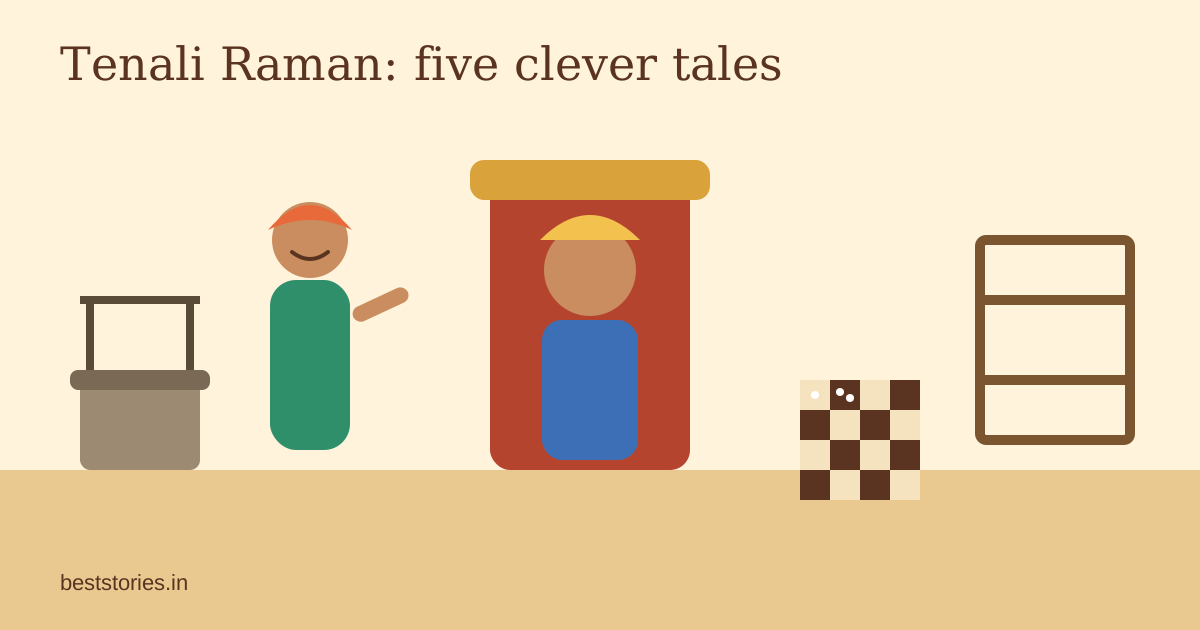
Every child loves the moment when the small, quick-thinking person beats the big, proud one. In South India, that person has a name: Tenali Raman. For generations, grandparents have told stories about this witty poet who could talk his way out of any trouble, catch a cheat without raising his voice and make a king laugh at his own mistakes.
This guide explains who Tenali Raman was, then retells five of his best-loved stories in short form, each with its lesson and a question to ask your child afterwards. They are short enough to tell at bedtime without a book.
Who was Tenali Raman?
Tenali Raman, also called Tenali Ramakrishna or Tenali Rama, was a Telugu poet linked with the court of Krishnadevaraya, who ruled the Vijayanagara Empire in the early 1500s. He is remembered as one of the Ashtadiggajas, the eight celebrated poets of that court, and his serious writing includes the Telugu poem Panduranga Mahatmyamu. A short overview is on Wikipedia’s Tenali Rama page.
The funny stories are a different matter. They grew up around his name over centuries and were passed on by word of mouth, in comics, on television and in school readers. Like many folk tales, the details change from teller to teller, and few historians would treat them as real events. That does not matter for children. What matters is the pattern: a problem, a proud or greedy person, and a clever idea that sets things right.
Why these stories work so well for children
- The hero wins with his head, not his fists. Tenali Raman never fights. He solves problems by noticing what others miss.
- Children can guess the trick. Each story has a moment where you can pause and ask, “What do you think he will do?”
- They are funny. Laughter keeps children listening, and the lesson slips in without a lecture.
5 Tenali Raman stories for kids
1. The Thieves and the Well
One summer the rains failed, and Tenali Raman’s garden was drying up. Drawing water from the deep well was hard work. One night he noticed a few thieves hiding behind the bushes, watching his house.
Tenali Raman smiled and spoke loudly to his wife. “Times are bad and there are thieves about. Let us put all our gold and jewels in the big box and drop it into the well, where nobody will think to look.” Then he filled a heavy box with stones and dropped it in with a great splash.
As soon as the lights went out, the thieves rushed to the well and began pulling up bucket after bucket of water to reach the treasure. They poured the water out on the ground, right where the plants were growing. They worked all night. Near dawn, Tenali Raman stepped outside and called, “Thank you, friends! My garden has not had this much water in weeks. You may go home now.” The thieves ran, and they never came back.
The lesson: a calm, clever plan can turn a problem into a help. Ask your child: How did Tenali Raman know the thieves would listen?
2. Rice on the Chessboard
The king was so pleased with Tenali Raman one day that he said, “Ask for any reward you like.” Tenali Raman pointed to a chessboard. “Just a little rice, Your Majesty. One grain on the first square, two on the second, four on the third, and double again on every square until the board is full.”
The courtiers laughed at such a small request. The king agreed at once and called for a bag of rice. But the bag ran out before the board was half done. Then a sack ran out. Then the storeroom. By the last squares, the grains needed were more than all the rice in the kingdom, and in the world.
The king laughed at himself and gave Tenali Raman a fair reward instead. The same puzzle is told about other clever people in other countries, which shows how much people everywhere enjoy it.
The lesson: small things that keep doubling can grow huge, so think before you promise. Ask your child: How many grains go on the fifth square? Count it out together: 1, 2, 4, 8, 16.
3. The Invisible Cloth
A smooth-talking weaver arrived at the court with an empty loom. “I weave a cloth so fine that only good and honest people can see it,” he said. He asked for gold thread and plenty of money, and every day he pretended to weave. Courtiers came to look, saw nothing, and were afraid to say so in case people thought they were dishonest. “Beautiful!” they all said.
Tenali Raman watched for a few days. Then he suggested that the weaver should be given the honour of carrying the finished cloth himself and draping it over the king’s throne in front of the whole court. The weaver stood there, holding nothing, while everyone waited. Finally a small child near the front said, “But there is nothing there.” The court burst out laughing, the weaver confessed, and the gold was returned.
If this sounds familiar, it is a close cousin of Hans Christian Andersen’s The Emperor’s New Clothes.
The lesson: do not pretend to see what is not there just because everyone else does. Ask your child: Why were the courtiers afraid to tell the truth?
4. The Painter’s Missing Pieces
A court painter had covered a palace hall with portraits, but every face was painted from the side, showing only one eye and one ear. When Tenali Raman asked where the other half of each face was, the painter waved him away. “Use your imagination,” he said. “A true art lover imagines the rest.” The courtiers laughed, and Tenali Raman said nothing.
A few weeks later, Tenali Raman invited the king to see a painting of his own. On the wall there was a single ear, a swishing tail, one hoof and a few leaves. “Where is the horse?” asked the king. Tenali Raman bowed. “Use your imagination, Your Majesty. A true art lover imagines the rest.” The king understood at once and roared with laughter, and after a while, so did the painter.
The lesson: a clever-sounding excuse is not an answer to a fair question. Ask your child: Why did Tenali Raman use the painter’s own words?
5. The Scholar and the Bundle
A visiting scholar announced that he knew the answer to every question in the world, and that no one at court could defeat him in debate. The court poets were nervous. Tenali Raman arrived carrying a large bundle wrapped in silk.
“Learned sir,” he said, “before we debate, please tell us what is in this bundle.” The scholar frowned. “I cannot know that without opening it.” “But you know the answer to every question,” said Tenali Raman. The scholar had no reply. When the bundle was opened, it held nothing more than a plain stick of sugarcane. The scholar laughed, admitted that no one knows everything, and left with a little more humility.
The lesson: nobody knows everything, and it is wise to say “I don’t know.” This pairs well with The Blind Men and the Elephant. Ask your child: What would you have guessed was in the bundle?
A note for parents
Some traditional Tenali Raman stories include tricks that are unkind to animals or that rely on fooling people in ways we would not want children to copy. We have left those out. If your child hears one elsewhere, it is a good chance to talk about the difference between a clever idea and a mean one.
How to tell Tenali Raman stories at home
- Pause before the trick. Stop just before Tenali Raman’s clever move and ask your child to guess. Half the fun is the guessing.
- Give the king a voice. A grand, slightly pompous voice for the king makes the ending funnier.
- Swap the setting. Older children enjoy retelling a story in their own school or neighbourhood. Who would be the proud weaver today?
Our guide on how to tell stories to kids without a book has more ideas. For another set of Indian tales with clear lessons, try our Jataka tales for kids and the best Panchatantra stories for kids, or browse our funny stories and moral stories for children in English.
Frequently asked questions
Was Tenali Raman a real person?
Yes. Tenali Ramakrishna was a Telugu poet linked with the court of King Krishnadevaraya of Vijayanagara in the early 1500s. But most of the funny stories about him grew up later as folklore, so it is best to enjoy them as tales rather than history.
What is the difference between Tenali Raman and Akbar-Birbal stories?
Both are about a clever courtier who outwits proud or greedy people in front of a king. Tenali Raman stories come from South India and the Vijayanagara court, while Akbar-Birbal stories are set at the Mughal court in the north. Some plots are told about both.
What age are Tenali Raman stories good for?
Most children enjoy them from about five or six, when they start to get a joke that depends on a trick. Older children like spotting the clever move before the ending.