
Honesty Stories for Kids: 4 Short Tales Where Truth Wins
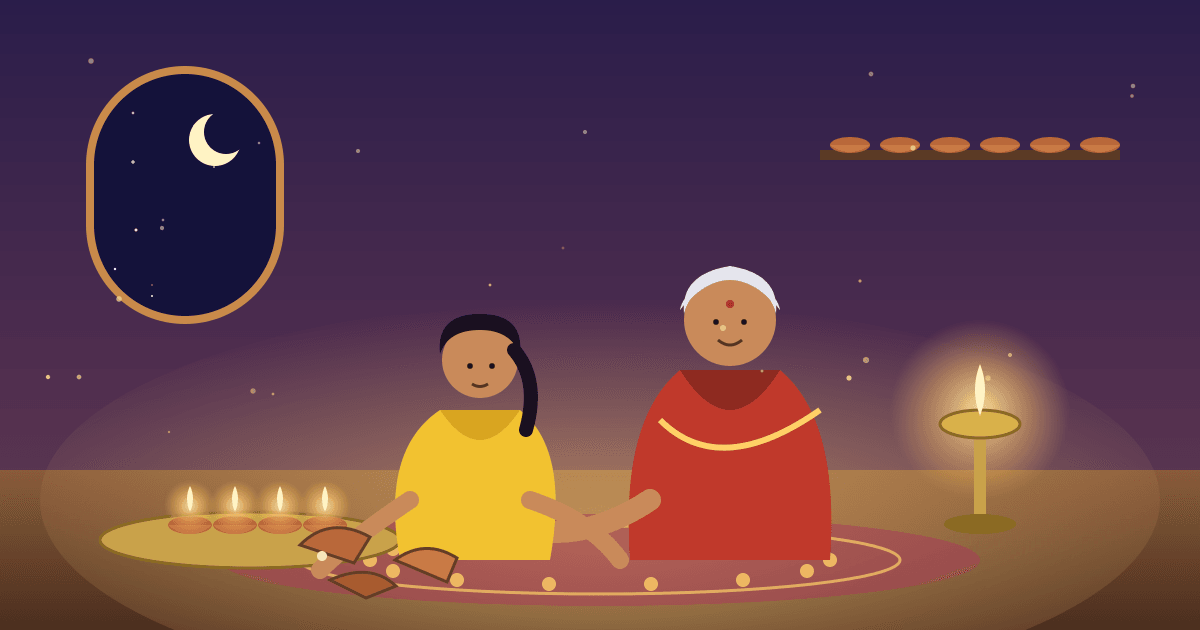
The honesty stories most likely to help are the ones that end well for the child who tells the truth. That is the finding at the centre of a well-known 2014 study of children aged 3 to 7: stories that showed the positive result of honesty made children more likely to own up, while stories that dwelt on the punishment for lying did not. So the four original stories below all follow one pattern. A child does something wrong, tells the truth, and finds that the truth is met with relief, help or a second chance.
They are written for reading aloud to children of about 4 to 10, in settings an Indian family will recognise: a clay lamp before Diwali, a laddoo from the temple, a vegetable seller's change, a teacher's red pen. Each is followed by one question to ask afterwards. If you are looking for a shorter set for a class, our five two-minute stories for school assembly cover honesty alongside kindness and fair play.
What the research says about honesty stories
In the study, published in Psychological Science in 2014, researchers compared four classic stories with 3- to 7-year-olds. Pinocchio and The Boy Who Cried Wolf did not reduce lying. The apocryphal story of George Washington and the cherry tree significantly increased truth-telling. The researchers' explanation is that the Washington story emphasises the positive consequences of honesty, while the other two focus on the negative consequences of dishonesty. When the Washington story was rewritten to focus on the bad result of lying, it stopped working too. The abstract is on PubMed.
Two honest cautions. This is one study in a research setting, so it does not promise that any story will change behaviour at home. And it covers young children; it says nothing about teenagers. What it does give a parent is a simple test for any story you choose: after the lie, does the character feel the truth was worth telling? If the only message is "liars get caught", the story is probably not doing much.
1. The Cracked Clay Lamp (ages 4 to 6)
Two days before Diwali, Meera was allowed to carry one of Ajji's clay lamps from the shelf to the front step. It was the biggest one, with a little elephant pressed into its rim. "Hold it with both hands," said Ajji, and Meera did, until a cat leapt off the wall and she jumped.
The lamp hit the step and split into three pieces. Meera stood very still. The cat was gone. Ajji was in the kitchen. Nobody had seen.
She could put the pieces behind the water pot. She could say the cat did it, which was nearly true. She picked up the piece with the elephant on it and found that her hands were shaking.
Then she walked into the kitchen and held out all three pieces. "Ajji, I dropped it. I jumped because of the cat, but I was the one holding it. I am sorry."
Ajji wiped her hands slowly. Meera waited for the shouting. Instead, Ajji took the piece with the elephant, turned it in the light and said, "Thank you for bringing it straight to me. A broken lamp is only clay. A child who hides things from her grandmother would be much sadder."
That evening they glued the three pieces with a paste of rice flour and chalk, and Ajji put the mended lamp at the very front of the row on Diwali night, crack and all. "This one," she told the visitors, "is the lamp that came to find me."
Ask: Why did Ajji put the cracked lamp at the front? How did Meera feel after she told her?
Parent note: Under about age 6, a child may truly half-believe "the cat did it", because fantasy and reality blur. Meera's line "I was the one holding it" is the thing to model: the whole truth, said simply, with no blame passed on.
2. The Laddoo That Was Not for Him (ages 5 to 7)
After the evening prayer, Arjun's mother kept a plate of laddoos on the high shelf. "One for each of you tomorrow morning, after the puja," she said. Arjun had seen five laddoos on the plate. His sister Tara had seen them too.
In the night Arjun woke up hungry. He pulled a stool to the shelf, took one laddoo and ate it in the dark, crumbs falling on his pyjamas. It was delicious and it made his stomach feel strange.
In the morning there were four laddoos and three children. His mother counted twice. "Who took one?" Tara looked at Arjun. Arjun looked at his feet. "Maybe a mouse," he said, and nobody smiled.
All through the puja he thought about the mouse. A mouse would have left a nibble, not a whole laddoo. When the prayer ended he went to his mother and said very fast, "It was me. I was hungry. I did not say so. I am sorry I said a mouse."
His mother knelt down. "Thank you for saying it before I had to find out," she said. "Now you may not have a laddoo today, because you have already had yours. But next time you wake up hungry, come and wake me, and I will give you milk." Then she cut her own laddoo in two, gave Tara half and kept half for herself, so that everyone had something.
Arjun's stomach, strangely, felt better at once.
Ask: Why did Arjun feel better after he told his mother? What could he do next time he is hungry at night?
Parent note: Notice that the consequence is real but small (no second laddoo) and that the story gives the child something to do instead (wake Mother). Child Mind Institute advises against cornering a child with a question you already know the answer to; the mother here simply counts and asks who took one, and leaves room for the child to come forward.
3. The Wrong Change (ages 7 to 9)
Every Saturday Karthik went to Ramu Chacha's stall at the corner to buy bananas. That morning he held out a fifty-rupee note for a bunch that cost thirty-two. Ramu Chacha was busy with three customers at once. He pressed some coins into Karthik's palm without looking and turned away.
Karthik counted on the walk home. Thirty-two from fifty should be eighteen. He was holding thirty-eight. It was a small amount, and it was exactly the price of the cricket cards he had been looking at for a week.
He took four steps toward the cards. Then he thought of Ramu Chacha, who had been selling bananas on that corner since before Karthik was born and who counted his money every evening on an old tin plate.
He turned round. The queue was still there. He waited his turn and said, "Chacha, you gave me twenty too much. Here."
Ramu Chacha looked at the coins and then at the boy. "Twenty rupees is a good day's tea for me," he said. "Most people would have kept it." He chose the biggest, yellowest banana in the bunch and added it for free. "From now on, beta, you take your bananas and pay me on Monday if you are ever short. I know who you are."
Karthik did not buy the cricket cards that Saturday. But in the weeks after, when his father was away and the pocket money ran late, the bananas still came home, and Ramu Chacha only smiled and said, "Monday is fine."
Ask: What did Karthik lose by returning the money? What did he gain that he could not have bought?
Parent note: This story shows the long-term payoff of a reputation for honesty, an idea older children can grasp. You might ask them whether the story would still be worth reading if Ramu Chacha had only said thank you. The honest answer is yes: Karthik did the right thing before he knew there would be a reward.
4. The Red Pen Mark (ages 8 to 10)
Divya had worked hard for the maths test, and she was proud when the paper came back with a big 20 out of 20 in red at the top. She showed it to her friend Shreya, who whistled. "Top of the class."
Then, at her desk, Divya looked at question 7 again. She had written 48 and the correct answer, which she now remembered working out at home, was 42. The teacher had missed it. Her paper had a tick where it should have had a cross.
She slid the paper into her bag. Nobody else would ever know. The class prize for the term went to the best total, and she was only two marks ahead of Shreya.
All afternoon the tick on question 7 seemed to get larger. At home she turned the paper over and over. At dinner she could not finish her rice.
On Monday she waited until the others had left, went to Miss Fernandes's desk and said in a small voice, "Miss, you gave me full marks on question 7, but my answer is wrong. It should be 18 out of 20."
Miss Fernandes took the paper and checked it. She did not say anything for a moment. Then she crossed out the tick, wrote 18, and looked up. "Divya, in twenty years of teaching I can count on one hand the children who have told me the mark was too high," she said. "The prize this term goes by the marks. But I want you to know what I think of your marks. Yours are the ones I trust."
Shreya won the term prize by a mark. Divya clapped louder than anyone. When Miss Fernandes needed a student to check the class answer sheets for next term, she did not hesitate.
Ask: Divya lost the prize. Was she right to speak up? What did she keep that a prize cannot give?
Parent note: Children over 6 know exactly what a lie is, so this is the age to talk about the cost of honesty, not only the reward. It is fine for the story to leave a real loss. The AAP notes that many children who lie are trying to save face under high expectations, so pair this story with a calm "I would rather know about a wrong mark than not".
What to do when your own child lies
A story helps, but what you do in the moment matters more. The American Academy of Pediatrics describes a first lie in a loving home as usually a sign that the child knows they did something wrong and fears disappointing you; it shows the conscience is working. Its advice is practical:
- Say at once that you know the truth, and keep your voice level. Harsh punishment is usually not very effective, and an extreme reaction can push a child to lie again.
- Make two points in words and in behaviour: you want to hear only the truth, and a child who tells the truth gets in much less trouble than a child who lies.
- Do not corner them. Child Mind Institute suggests that if you already know what happened, go straight to the issue ("I know you didn't do it. Let's talk about why that's not a good idea") rather than asking a question you know they may answer with a lie.
- Model honesty yourself. The AAP says your own behaviour is probably the most important way to teach it, and warns that children get confused when they are told never to lie but hear a parent shade the truth on the phone.
- Thank them when they come forward, and let the consequence be smaller than it would have been after a lie.
If lying becomes a pattern, the AAP and the American Academy of Child and Adolescent Psychiatry both advise talking to a counsellor or child mental-health professional, since repeated lying can signal stress, learning or attention difficulties, or something else a child is trying to hide.
How to read these stories well
- Read it once without stopping, then ask the closing question and wait. A silence of five seconds is normal.
- Let your child retell it in their own words a day later. Our guide to telling stories to kids without a book shows how.
- If they ask for the same story again and again, that is fine and often useful; we explain why in why kids want the same bedtime story.
- Ask "What would you have done?" before "What should he have done?". The first one gets an honest answer. For more question ideas see dialogic reading at home.
- For a calmer story about waiting rather than owning up, try The Mango Seed Promise, and for traditional tales with morals see our moral stories for children guide.
Frequently asked questions
What is the best way to teach honesty to a young child?
Show it and reward it. Pediatric guidance stresses that your own behaviour is probably the most important lesson, and a 2014 study found that a story showing the good result of telling the truth increased honesty in children aged 3 to 7, while stories about the punishment for lying did not. Thank your child when they tell you something difficult, and keep the consequence smaller than it would have been after a lie.
At what age do children understand the difference between truth and lies?
The American Academy of Pediatrics says children under about 6 often find it hard to separate fantasy from reality, so a very small child's tall tale is not always a deliberate lie. After about age 6 they can tell the difference clearly, which means a lie from an older child is a choice. Use the first two stories below for ages 4 to 7 and the last two for 7 to 10.
Should I punish my child for lying?
Harsh punishment is usually not effective, according to the American Academy of Pediatrics. Parents who overreact can push a child to lie again to protect themselves. A calmer approach is to say you know the truth, ask them to tell you the whole of it, and make clear that they will be in much less trouble for being honest.
Is the story of the boy who cried wolf good for teaching honesty?
It is a classic, but in the 2014 study it did not make children more honest, and neither did Pinocchio. Stories that focus on what goes wrong for the liar did not help; stories that show how welcome the truth is did. The Boy Who Cried Wolf is still worth reading for the fun of it, but follow it with a story where the truth-teller is glad they spoke.
About these stories
The four stories are original, written by the BestStories Editorial Desk for this article, so there is no source for their plots. Ages given are our own suggestion for reading aloud, not a research finding. The advice sections summarise the sources listed below and are general parenting information, not medical or clinical advice.
Sources
- Lee, K., Talwar, V., McCarthy, A., Ross, I., Evans, A. and Arruda, C. (2014). Can classic moral stories promote honesty in children? Psychological Science 25(8):1630-1636 (PubMed abstract: stories compared, results for Pinocchio, The Boy Who Cried Wolf and George Washington and the Cherry Tree).
- American Academy of Pediatrics, HealthyChildren.org. When Children Lie: What Parents Can Do (fantasy and reality under age 6, why children lie, harsh punishment, modelling honesty, when to seek help).
- Child Mind Institute. Why Kids Lie and What Parents Can Do About It (reasons children lie, not cornering a child).
- American Academy of Child and Adolescent Psychiatry. Lying and Children (repetitive lying and when to get a professional evaluation).
Written by the BestStories Editorial Desk. All stories are original and free to read aloud at home and in class with credit.