Short Moral Story About Patience: The Mango Seed Promise
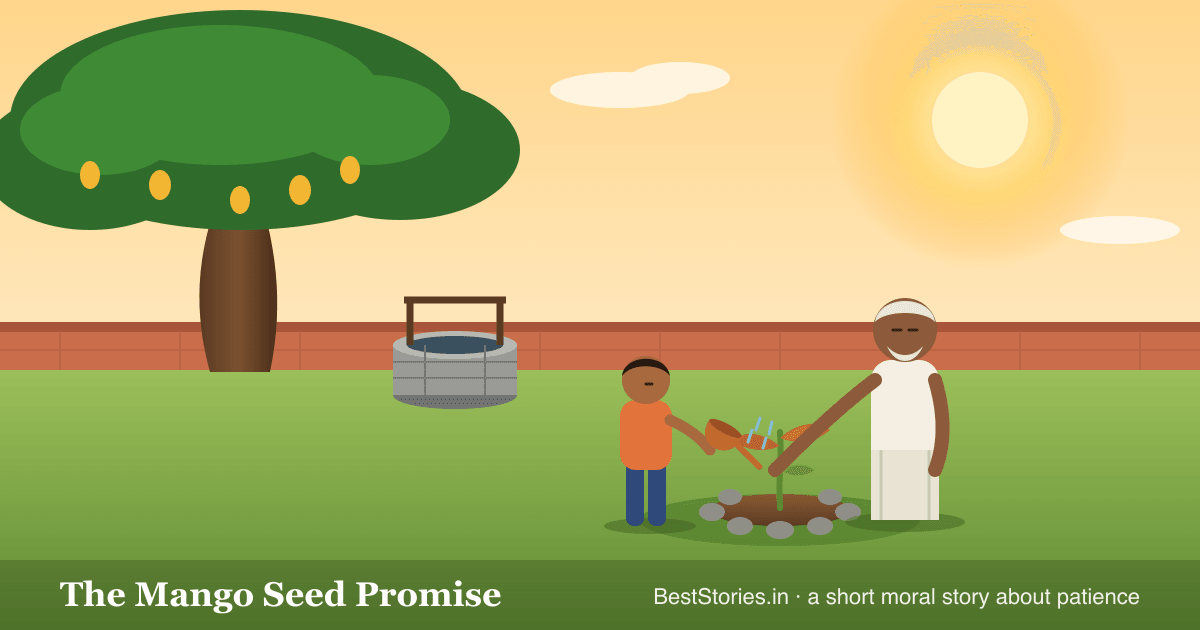
Children are told to be patient all the time, but patience is hard to understand when you are seven and everything you want seems to take forever. A short story can show what patience looks like better than any explanation. The Mango Seed Promise is an original moral story about Ravi, his grandfather and a mango seed that refuses to hurry. It takes about four to five minutes to read aloud.
After the story you will find the moral in one line, a simple ten-minute routine for reading moral stories at home, notes on where to pause, and questions to talk about. If you want a longer collection, our moral stories for children in English has fifteen short tales grouped by value.
The Mango Seed Promise
Ravi loved mangoes more than any fruit in the world.
One summer afternoon, his grandfather chose the sweetest mango from the basket and gave it to him. Ravi ate it under the neem tree, juice running down his wrist, and wiped his chin with the back of his hand.
When only the seed was left, he lifted his arm to throw it over the wall.
“Do not throw the seed,” Grandfather said. “Plant it.”
Ravi looked at the hard, hairy seed in his palm. “Will it give mangoes tomorrow?”
Grandfather laughed. “Not tomorrow.”
“Next week?”
“No.”
“Then why plant it?”
Grandfather pointed to the old mango tree beside the well. Its branches were so wide that the whole family sat in its shade on hot afternoons. “Because someone planted that one before you were born.”
Ravi did not like slow things. He liked cricket balls that flew fast, kites that rose fast and snacks that disappeared fast. Still, he dug a small hole near the garden wall, dropped the seed inside and covered it with soil.
“Now what?” he asked.
“Now we care for it,” said Grandfather. “That is the promise.”
For three days, Ravi watered the spot carefully. On the fourth day, the soil looked exactly the same.
“It is not working,” he said, kicking a pebble.
“Some good things work under the soil first,” Grandfather replied.
Ravi watered it for one more day. Then a school project came. Then a cricket match came. Then his cousins came to stay for the holidays. Soon the mango seed was forgotten.
Two weeks later, Grandfather took Ravi by the hand and walked him to the garden wall.
“Look,” he said.
A tiny green shoot had pushed up through the soil. It was thin and bent, with two shy leaves the colour of copper.
Ravi’s eyes went wide. “It came! Even when I forgot it, it came!”
“Yes,” said Grandfather. “The seed kept its side of the promise. But look how small it is.”
Ravi crouched down. The shoot looked far too thin to become anything important. A goat could eat it in one bite. One careless foot could crush it.
“Will it really become a tree?”
“If we keep our side of the promise.”
That sentence stayed with Ravi all evening.
The next morning, he watered the shoot before school. In the evening, he checked that the neighbour’s goats had not come near it. On Sunday, he placed a ring of small stones around it so that no one would step on it, and when the monsoon rain beat down hard, he propped an old basket over it until the storm passed.
Some weeks, nothing seemed to change. Ravi kept caring for it anyway.
Months passed. The plant grew more leaves. The leaves grew darker and stronger. The stem became a little trunk. Ravi grew taller too, though he did not notice that as much.
One afternoon, a small girl from next door watched him filling his water pot.
“Will it give mangoes tomorrow?” she asked.
Ravi smiled. “Not tomorrow.”
“Next week?”
“No.”
“Then why do you look after it?”
Ravi looked at the old mango tree beside the well, then at the young tree beside him.
“Because one day someone will sit in its shade,” he said, “and maybe they will not even know my name.”
Grandfather, resting on the step, closed his eyes and smiled.
Moral of the story
Good work does not always give quick results. Some promises matter because they help someone later. Ravi’s patience was not waiting and doing nothing. It was watering, guarding and caring for something on the days when nothing seemed to change.
Why a patience story works better than a reminder
“Be patient” is an instruction. A story is an experience. When a child hears Ravi kick the pebble and say “it is not working”, they recognise their own frustration, and when the shoot finally appears they feel the reward with him. That is why a short story often lands where repeated reminders do not.
The mango seed is also an honest example. A mango tree grown from a seed takes years before it gives fruit, so the story does not pretend that patience is rewarded the next day. Ravi’s real reward is seeing the tree grow and knowing that someone else will enjoy it later, which is a gentle way to introduce the idea of doing good without needing praise.
Reading the story aloud matters too. Reading Rockets, a US literacy project, describes reading aloud as one of the most important things adults can do with children, because it builds vocabulary, models expressive reading and makes stories enjoyable. Its article on repeated interactive read-alouds also explains why reading the same story more than once, with a little conversation each time, helps young children understand it more deeply.
A 10-minute moral story routine for home
A moral story is more useful when it becomes a small, repeatable habit rather than a one-off reading. This routine fits into ten minutes, before bed or after dinner.
- Settle (2 minutes). Sit together and tell your child the title. Give one thing to listen for, such as “Listen for the moment Ravi wants to give up.”
- Read (5 minutes). Read slowly. Slow down most at the choice points, where a character could go either way.
- Talk (3 minutes). Ask one open question, then ask your child to say the moral in their own words. Finish by linking it to one ordinary situation from their week.
Keep it light. The aim is a conversation, not a test. If you want more question ideas for every age, our guide to dialogic reading at home explains a simple prompt-and-respond pattern, and how to tell stories to kids without a book shows how to retell a story like this one from memory on nights when you have no screen or book to hand.
Read-aloud notes for parents and teachers
- Pause after “Then why plant it?” Ask what your child thinks Grandfather will say. Their guess tells you how they think about waiting.
- Let the forgetting land. When Ravi forgets the seed, do not rush past it. Most children forget things they promised to look after, and it helps to see that the story does not shame him for it.
- Pause again when the shoot appears. Ask why the plant still needs care even though it has started to grow.
- Use a different voice for the neighbour girl. Her questions echo Ravi’s at the start. Older children often notice the repetition and enjoy pointing it out.
- Connect it to real life. For older children, link the story to practising an instrument, saving money, learning to read, caring for a pet or helping a younger sibling.
Questions to talk about
- Why did Ravi first think planting the seed was pointless?
- What did Grandfather mean by “some good things work under the soil first”?
- What made Ravi start caring for the plant again?
- How did Ravi’s answer to the neighbour girl show that he had changed?
- What is something you are learning that takes time, like a mango tree?
- What is one small thing you could do today that might help someone later?
A simple weekly plan
Once or twice a week is enough to build the habit. One easy rhythm is to pair each story with a single value and a single question:
- Patience: read this story and ask, “What took time, and was it worth it?”
- Kindness: read The Lantern That Waited, our bedtime story about listening, and ask, “Who helped without being asked?”
- Cleverness and honesty: choose one of the Akbar Birbal stories or Panchatantra stories for kids and ask, “Was the clever choice also the fair one?”
You can find more short tales with a clear lesson in our moral stories collection.
Frequently asked questions
What is this short moral story about?
It is an original story about Ravi, a boy who plants a mango seed with his grandfather and learns that some good things grow slowly and need care long before they give anything back.
What is the moral of The Mango Seed Promise?
Good work does not always give quick results. Patience means keeping a promise even when nothing seems to be happening, because what you care for today may help someone later.
What age is this story suitable for?
It suits children aged about 5 to 10 and takes four to five minutes to read aloud. With children under five, read only the planting scene and the moment the shoot appears.
How do I use a moral story without it feeling like a lecture?
Read slowly, pause at the main choice, ask one open question and let your child put the moral in their own words before you add yours. One honest answer is worth more than a long explanation.
You are welcome to read this original BestStories story aloud at home, in class or at a library story time. Please link back to this page if you share the text online.