Bedtime Story About Listening: The Lantern That Waited
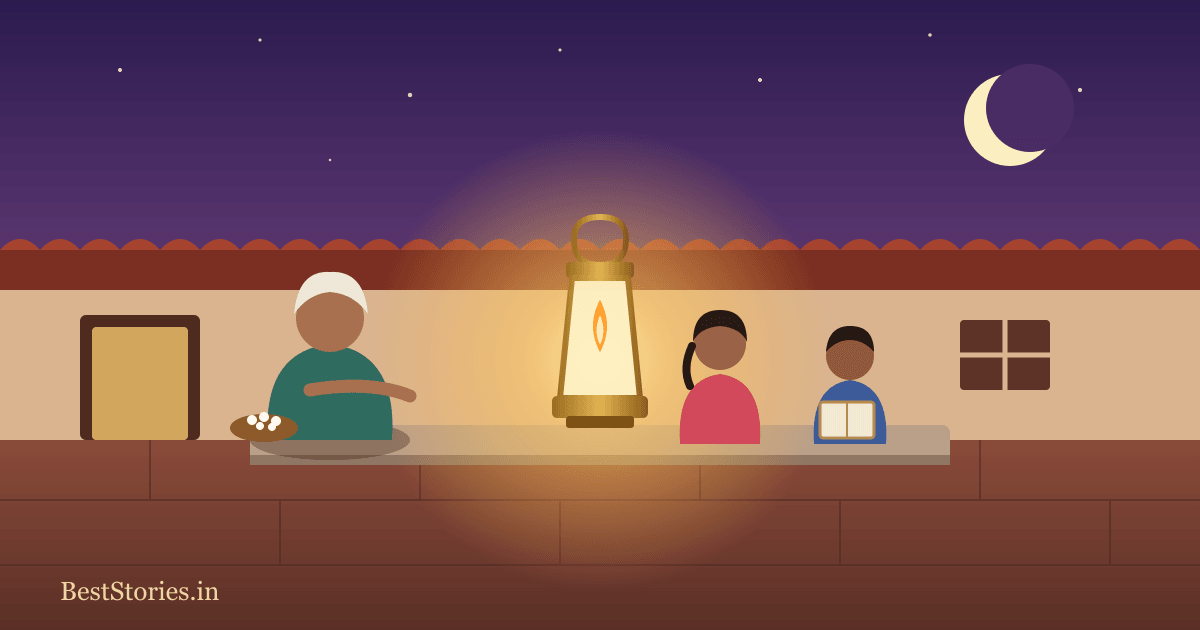
Some bedtime stories are for adventure and some are for laughter. This one is for the quiet moment when a child is ready to hear that listening can be a kind of love. The Lantern That Waited is an original story about Nila, her grandmother and her cousin Dev, and it takes about eight minutes to read aloud.
Read it slowly and let the pauses do the work. The moral is simple enough for a five-year-old but useful for adults too: when we listen properly, people feel less alone. After the story you will find the moral, a few read-aloud notes and questions to talk about before lights out. If your child is younger, our short bedtime stories for toddlers are a gentler place to start.
The Lantern That Waited
Every evening, when the sky turned purple and the first kitchen lights came on, Nila’s grandmother lit a brass lantern in the courtyard.
The lantern was old. Its glass had tiny scratches. Its handle was dark from many hands. But when Grandmother touched a match to the wick, the flame rose bright and steady, and the courtyard became a small golden room without walls.
That was story time.
Nila loved story time, but she did not love waiting.
“Grandmother, tell the one about the hidden palace,” she said one evening.
“In a minute,” Grandmother replied. “First, let me finish sorting these jasmine flowers.”
Nila sat on the step and tapped her heel. “Now?”
“Almost.”
“Now?”
Grandmother smiled without looking up. “The lantern has more patience than you.”
Nila looked at the lantern. It stood quietly beside the stone bench, shining on the jasmine basket, the clay water pot, the red tiles and Grandmother’s silver hair.
“It does not have patience,” Nila said. “It is just a lantern.”
“Maybe,” said Grandmother.
That word bothered Nila. Grandmother said “maybe” when she knew something but wanted Nila to discover it herself.
The next evening, Nila decided to test the lantern. When Grandmother went inside to bring tea, Nila leaned close and whispered, “If you are patient, show me.”
The lantern did nothing.
Nila frowned. “I knew it.”
Then she heard a small sound from the gate. Her younger cousin Dev had arrived, dragging his school bag behind him. His face looked tight and angry.
“What happened?” Nila asked.
“Nothing,” Dev said.
Nila knew that kind of nothing. It was a heavy nothing.
“Come and hear a story,” she said. “Grandmother will tell one soon.”
Dev sat beside her, but he did not smile. He pressed his fingers into the dust and drew a crooked line.
Nila wanted to ask again. She wanted to say, “Tell me quickly before the story starts.” She wanted to guess. Had someone taken his pencil? Had he lost a race? Had the teacher scolded him?
But the lantern was between them, shining quietly, and Nila remembered Grandmother’s words: the lantern has more patience than you.
So Nila did something difficult. She waited.
For a long time, Dev drew lines in the dust. One line became a road. Another became a house. Then he rubbed them all away with his palm.
At last he said, “Everyone laughed when I read.”
Nila turned towards him.
Dev’s voice became smaller. “I read one word wrong. Then another. Then I forgot where I was. The whole class laughed.”
Nila wanted to say, “That happened to me once.” She wanted to say, “Don’t worry.” She wanted to say something clever that would fix it fast.
But Dev was still looking at the dust, and the lantern was still shining quietly. So Nila waited again.
Dev took a breath. “I don’t want to read tomorrow,” he said.
Now Nila understood. Dev did not need a quick answer. He needed room for the whole hurt to come out.
Grandmother came back with the tea and heard the last sentence. She did not rush either. She set the cups down, sat beside Dev and placed one jasmine flower in his hand.
“When I was small,” Grandmother said, “I once forgot a prayer in front of the whole family. My ears burned for two days.”
Dev looked up. “What did you do?”
“The next day, my brother sat with me and listened while I practised. He did not laugh. He did not hurry me. By evening, the words had found their way back.”
Dev held the jasmine flower carefully.
“I can listen while you practise,” said Nila.
“You won’t laugh?”
“Only if you read a funny word on purpose.”
Dev almost smiled.
So the hidden palace story waited. The tea cooled. The lantern burned a little lower.
Dev took a book from his bag and opened it at the difficult paragraph. At first his voice shook. He stopped at the long words. He mixed up two lines. Nila wanted to help too quickly, but Grandmother touched her shoulder. Wait, the touch said.
Nila waited.
Dev tried again. This time he reached the end.
“Again?” Nila asked. Dev nodded.
He read it three more times. By the fourth time, his voice sounded like himself.
The next evening, Dev came running through the gate. “I read today,” he said. “I made one mistake, but I kept going.”
Grandmother lit the lantern. The flame rose, golden and steady.
Nila looked at it and whispered, “You did show me.”
“Who did?” Dev asked.
“The lantern.”
Dev laughed. “Lanterns don’t talk.”
“No,” said Nila. “They listen.”
Grandmother smiled, and that night she finally told the story of the hidden palace. But Nila remembered another story more clearly: the story of a small boy, a difficult paragraph, and a lantern that waited long enough for someone to feel brave again.
Moral of the story
Listening is not just staying quiet. It is giving someone enough patience to say what they really feel. Nila’s kindness was not a clever answer or a quick fix. It was waiting, twice, when every part of her wanted to fill the silence.
Why this story works at bedtime
Bedtime is often the one part of the day when children finally talk about what happened at school. A story where a character takes their time and someone else simply waits gives your child a model for that moment, and it gives you one too.
Reading aloud also does more than settle a child for sleep. Reading Rockets, a US literacy project, describes reading aloud as one of the most important things parents and teachers can do with children: it introduces vocabulary, models fluent and expressive reading, and shows children what reading for pleasure feels like. Its guide to reading with your child also links read-alouds to social-emotional growth, which is exactly the ground this story covers. The UK’s National Literacy Trust tracks how much children enjoy reading, and shared, unhurried story time is one of the simplest ways to keep that enjoyment alive at home.
Dev’s worry is also a common one. Many children feel embarrassed after reading aloud in class. Hearing that a grown-up once felt the same way, as Grandmother admits, can make it easier for a child to tell you about their own difficult day.
Read-aloud notes for parents and teachers
- Start slowly. Read the opening courtyard scene in a calm, low voice so the story feels like evening.
- Use real pauses. Each time Nila waits, wait too. Count to three in your head before you read on. Children notice the silence and understand it.
- Pause after the key line. When Dev says, “Everyone laughed when I read,” stop and let it land before turning the page or carrying on.
- Notice the urge to fix things. Ask what Nila wanted to say and what she chose to do instead. That gap is the heart of the story.
- Keep the moral short. “Listening can make someone feel safe” is enough. You do not need a lecture at bedtime.
- Invite one memory. Ask your child to remember a time when someone really listened to them, and share one of your own.
If you like turning story time into a conversation, our guide to dialogic reading at home has simple question patterns for every age, and how to tell stories to kids without a book shows how to retell a tale like this one from memory on nights when the book is not to hand.
Questions to talk about
- Why did Dev say “nothing” when something was wrong?
- What did Nila want to do first, and what did she do instead?
- How did waiting help Dev speak honestly?
- Why do you think Grandmother told the story about forgetting her prayer?
- What does the lantern stand for in this story?
- Who is someone who listens to you? How do you know they are really listening?
More stories about kindness and patience
For more gentle stories with a clear lesson, browse our bedtime stories and moral stories collections, or read moral stories for children in English, a set of fifteen short tales that teach without preaching. The Jataka tales for kids also include several stories where patience wins over hurry.
Frequently asked questions
What is this bedtime story about?
It is an original story about a girl named Nila who learns, with the help of her grandmother and an old brass lantern, that waiting patiently and listening can help someone feel brave again.
What is the moral of the story?
Listening is a kind of kindness. When we do not rush people, interrupt them or hurry to fix things, they can say what they really feel.
What age is this story suitable for?
It suits children aged about 5 to 10. It takes around eight minutes to read aloud. For younger children, you can shorten the middle section and keep the ending.
Can I read this story aloud in class or at a library story time?
Yes. It is an original BestStories story written for reading aloud at home, in classrooms and at story circles. Please link back to this page if you share the text online.