
Children's Day Story for Kids: An Original Tale for 14 November
India celebrates Children's Day on 14 November, the birthday of Jawaharlal Nehru, and the best way to mark it with a child is to read a short story together and then talk about it. Below is an original five-minute story for ages 5 to 9, followed by the history of the day in plain words, how it differs from World Children's Day on 20 November, and a few ideas for home or class.
This year 14 November falls on a Saturday, so some schools will hold their programme on Friday 13 November or another working day. If you are a parent, you can simply read the story on the evening itself. If you are a teacher, the story and the questions after it fit comfortably into a ten-minute assembly slot.
Why India celebrates Children's Day on 14 November
Jawaharlal Nehru was born on 14 November 1889 and became the first prime minister of independent India. Children called him Chacha Nehru, Uncle Nehru, and his birthday became the day the country thinks about its children. According to Wikipedia's account of the day's history, it was first observed as Children's Day in 1954, when more than 50,000 schoolchildren gathered at the National Stadium in Delhi, and the government officially declared 14 November as Children's Day in 1957.
Nehru also wrote for children. Letters from a Father to His Daughter collects 30 letters he sent in the summer of 1928 to his ten-year-old daughter Indira, explaining nature and human history in simple language. It was first published in 1929, and it is still a good book to read in small pieces with an older child.
Whatever you think about history, the practical meaning of the day for a family is simple: it is a day to give children your full attention. That is the idea behind the story below.
Children's Day vs World Children's Day
The two days are easy to mix up. India's Children's Day is 14 November. World Children's Day is 20 November. The United Nations describes World Children's Day as UNICEF's global day of action for children, by children, marking the adoption of the Convention on the Rights of the Child on 20 November. The Convention was adopted in 1989 and, according to UNICEF, is the most widely ratified human rights treaty in history.
You do not need to choose. A good plan is to read a story on 14 November and, on 20 November, ask your child one real question about their life, such as what they would change about their school or street, and then listen to the whole answer. The story below shows what that looks like.
The Garden Behind the Wall (a story for ages 5 to 9)
Behind the old water tank, at the end of Lotus Lane, there was a patch of ground that nobody owned and nobody wanted. It held broken bricks, a rusted bicycle frame and more plastic bags than anyone could count. Grown-ups walked past it with their eyes on their phones.
Tara noticed it because her ball rolled in there one afternoon. When she climbed over the low wall to fetch it, she saw something the grown-ups had missed. In the corner, between two bricks, a single green shoot was pushing through the dust.
"It wants to live," Tara told her friends that evening. Jaswant said it was only a weed. Meena said weeds were plants too. Old Ibrahim, who sold peanuts at the corner, said that even a weed deserved a chance.
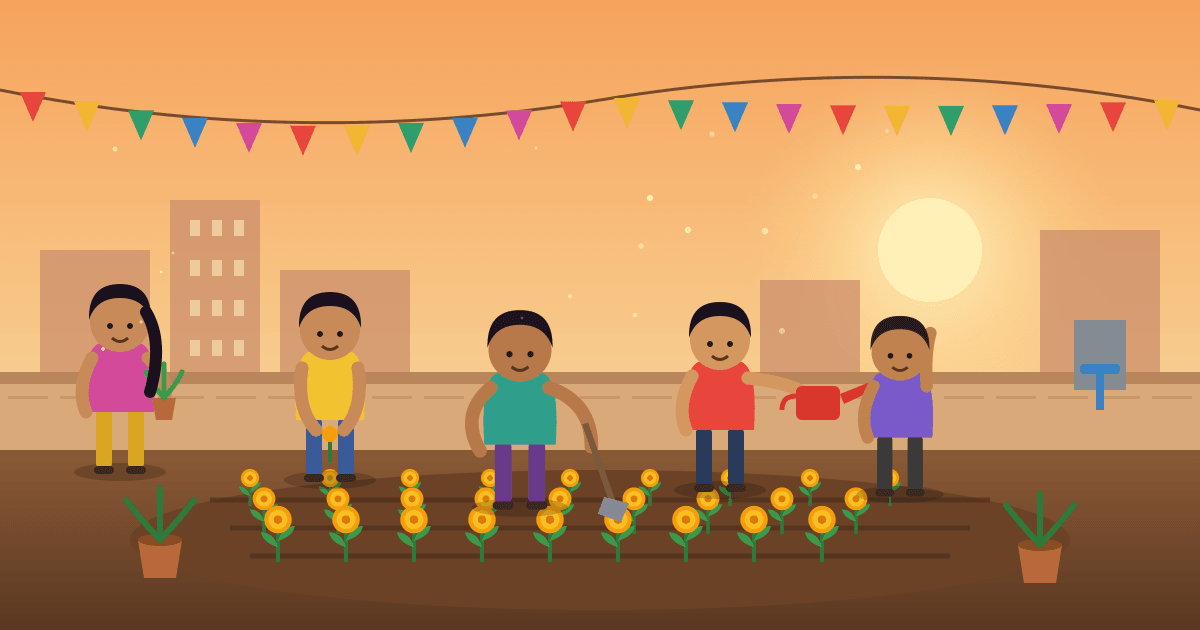
So on Saturday morning five children climbed over the wall with a bucket, two gloves between them and one borrowed spade. They carried out the bricks first, a few at a time, and stacked them neatly by the wall. Then they filled the plastic bags and tied them up. It took the whole day, and when the sun went down the ground looked bare and brown and a little sad.
"It looks worse than before," said Jaswant.
"It looks like a beginning," said Meena.
The next week they brought marigold seeds, and tulsi cuttings from Tara's grandmother, and a packet of coriander that Ibrahim handed over without being asked. They planted everything in rows, and they carried water from Tara's house in a red plastic can that leaked a little on the way. By the third trip, the water in the can was mostly on their shoes.
"We need a tap," said Tara, wiping her face. "A tap right here."
The lane's residents' committee met every month in the community hall. The children had never been to a meeting before. They sat at the back in a row, a little afraid of the big chairs, and when the secretary asked if there was any other business, Tara stood up. Her voice shook so much that she had to start twice.
"We cleared the ground behind the water tank," she said. "We planted marigolds and tulsi. We carry water from our homes, but it is too far. Please, could the lane put a small tap there?"
There was a long silence. Somebody coughed. A man in the front row said that the committee had a long agenda and that children's gardens could wait. Somebody else said a tap would cost money.
Then the oldest woman in the lane, Mrs Fernandes, stood up slowly with her stick. "When I walked past that ground this morning," she said, "I smelled marigolds for the first time in ten years. I think the children have asked us a fair question. We should answer it."
The committee voted. It was not unanimous, but it was enough. Two weeks later a plumber came, and a small tap with a blue handle was fixed to the wall of the water tank, low enough for a child to reach.
By the next Children's Day the marigolds were as tall as Tara's knees. People who had never spoken to each other sat on the low wall in the evenings and talked. Ibrahim brought his peanuts. Mrs Fernandes brought a folding chair. And over the tap, painted in uneven letters by five children, were the words: The Garden Behind the Wall. Everyone is welcome. Please ask the children first.
Questions to ask after the story
- What did Tara notice that the grown-ups missed? (Looking closely at small things.)
- Why do you think Tara's voice shook when she spoke at the meeting? (It is hard to speak up, even when you are right. Ask your child when they have felt like that.)
- What would have happened if Mrs Fernandes had stayed quiet? (One person listening can change a room.)
- What is one small thing near our home that could be better, and what could we ask for? (This turns the story into a real plan. Keep it small and doable.)
If your child enjoys this kind of story, try the five two-minute tales in Short Moral Stories for School Assembly, or the four tales in Honesty Stories for Kids.
Five simple ways to celebrate at home or in class
- Read aloud and then listen. After the story, ask one of the questions above and do not correct the answer. If you want ideas for making the conversation richer, see Dialogic Reading at Home.
- Let children plan part of the day. Let them choose the story, the snack or the game for the evening. Real choices matter more than a decorated classroom.
- Tell a story without a book. Tell a story from your own childhood. How to Tell Stories to Kids Without a Book has a simple method if you are nervous.
- Plant something small. A pot of marigold or tulsi on a windowsill is enough, and it echoes the story. It also gives the child something to look after for weeks.
- Read a classic. For older children, pick one of the letters from Nehru's book, or a Panchatantra tale from Best Panchatantra Stories for Kids.
A note for teachers
For a ten-minute assembly, read the story aloud (five minutes), ask two of the questions and take three or four answers, and end with one thing the class could ask for together. Pick something small that adults can actually say yes to: a reading corner, a plant by the gate, a new class rule about turn-taking. Children learn more from one request that is heard than from a speech about being heard. For younger classes the age-by-age reading guide helps with picking story length.
Frequently asked questions
When is Children's Day in India in 2026?
Children's Day (Bal Diwas) is on 14 November every year, the birthday of Jawaharlal Nehru. In 2026 it falls on a Saturday, so many schools hold their programme on the Friday before or on another working day. Check your school's circular for its own date.
Why is Children's Day celebrated on 14 November in India?
Because it is the birthday of Jawaharlal Nehru, India's first prime minister, who was known to children as Chacha Nehru (Uncle Nehru). Wikipedia's history of the day records that it was first marked as Children's Day in 1954 and declared the official day by the government in 1957.
Is Children's Day the same as World Children's Day?
No. India's Children's Day is on 14 November. World Children's Day is on 20 November, UNICEF's global day of action for children, and marks the adoption of the UN Convention on the Rights of the Child. They can be celebrated together, since both are about children's wellbeing and voices.
What kind of story is best for Children's Day?
A story where children are listened to and trusted with something real works better than one that lectures about being good. The tale below is about a group of children who ask for something fair and are heard, which fits the day's theme of children's rights and voices.
How long does the story take to read aloud?
About five minutes at a calm pace. It suits ages 5 to 9; younger children will enjoy it with pauses for the questions, and older children can read it to the class themselves.
About these stories
The story, The Garden Behind the Wall, is original, written by the BestStories Editorial Desk for this article; its characters, lane and committee are fictional. The history section summarises the sources listed below, including Wikipedia for the dates of the first and official Children's Day. Ages given are our own suggestion for reading aloud.
Sources
- Wikipedia. Children's Day (India) (14 November, Nehru, 1954 first observance, 1957 official declaration, Nehru and children, Letters from a Father to His Daughter).
- Wikipedia. Jawaharlal Nehru (born 14 November 1889; first prime minister of India).
- Wikipedia. Letters from a Father to His Daughter (30 letters, summer 1928, first published 1929).
- United Nations. World Children's Day, 20 November (UNICEF's global day of action; adoption of the Convention on the Rights of the Child).
- UNICEF. Convention on the Rights of the Child (adopted 1989; most widely ratified human rights treaty).
Written by the BestStories Editorial Desk. All stories are original and free to read aloud at home and in class with credit.